



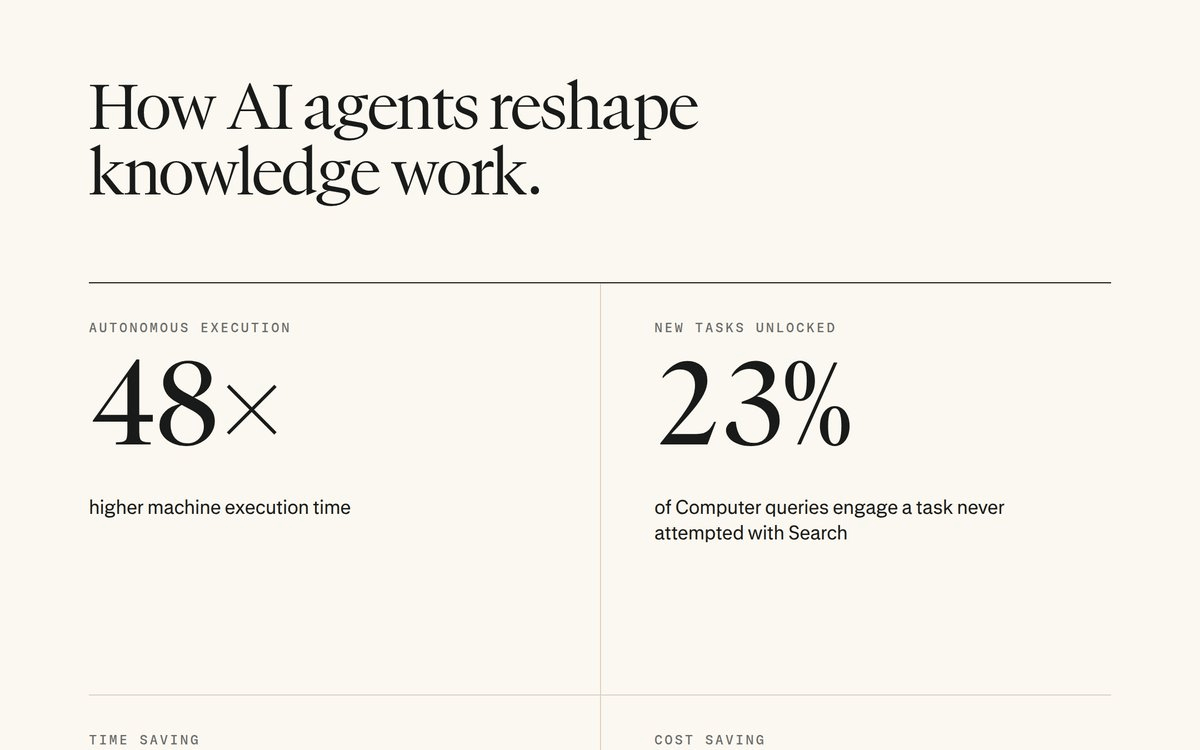
Most AI productivity research has focused on chatbots helping people write better emails or debug code faster. A new study from Perplexity and Harvard Business School goes further, asking a different question: what happens when you stop giving humans better answers and start giving them an agent that does the work itself?
The answer, based on three months of real production data, is striking. Workers using Perplexity Computer -- a general-purpose agent that plans, browses, codes, writes, and connects to external services autonomously -- completed the same tasks in 87% less time at 94% lower cost compared to humans using Search alone. And the quality went up, not down.
The Gap Between Answering and Doing
The core tension in AI-assisted work has always been the handoff. A search engine or chatbot gives you the answer. You still have to open the right tools, pull the files, run the code, edit the document, and decide what to do next. Every step is yours to execute.
Agents change that division of labor. A user specifies an outcome, and the system plans across tools, executes intermediate steps, asks for missing inputs when needed, and returns a finished deliverable. The user moves from operator to supervisor. That shift is what this study tries to measure -- rigorously, at scale, in the wild.
Perplexity launched Computer in 2026 as a general-purpose agent orchestrator that autonomously works toward user-specified objectives across complex environments and lengthy time horizons. The study compares it directly against Perplexity Search, which represents the classic "answer engine" paradigm.
How They Built the Comparison
The methodology is the most interesting part of the paper. You can't just compare random Search and Computer sessions -- the tasks are too different. So the researchers built a controlled comparison using matched pairs.
Across 10,000 matched pairs, the team identified sessions where the same user asked near-identical queries to both Search and Computer, and where Computer ran at least one execution tool. This gives you a natural experiment: the same underlying task, attempted with two different tools.
To estimate how long a human would take to complete the manual steps that Computer handles automatically, they used three independent methods:


Don't miss what's next in AI
Join 300,000+ engineers and researchers who get the signal, not the noise.
- Full access to in-depth AI research breakdowns
- Be the first to know what's trending before it hits mainstream
- Daily curated papers, repos, and industry moves