

Nous Research's Hermes Agent Ships a Loop Command That Watches CI for You
Hermes Agent's new /loop command lets you re-run any prompt on a recurring schedule, with smart self-pacing built in

- /loop is a new Hermes Agent slash command that re-runs any prompt on a recurring schedule inside your current session.
- Two modes: fixed interval (e.g.
/loop 5m <prompt>) or self-paced, where Hermes backs off exponentially when nothing changes and snaps back when it does. - Supports stop conditions via
--times N,--until <condition>, orLOOP_COMPLETEemitted by the agent itself. - Works across CLI, desktop app, and all messaging gateways (Telegram, Discord, Slack, WhatsApp, and more).
- Fills the gap between
/goal(objective-driven) and cron (unattended schedules) -- best for polling, CI watching, and session-scoped monitoring. - Full docs here; Hermes Agent is MIT licensed and free to self-host.
Hermes Agent, Nous Research's self-improving AI agent framework, just shipped /loop -- a slash command that turns any prompt into a recurring agent task inside your current session. It's a small surface area with a surprisingly useful set of behaviors underneath.
What it does
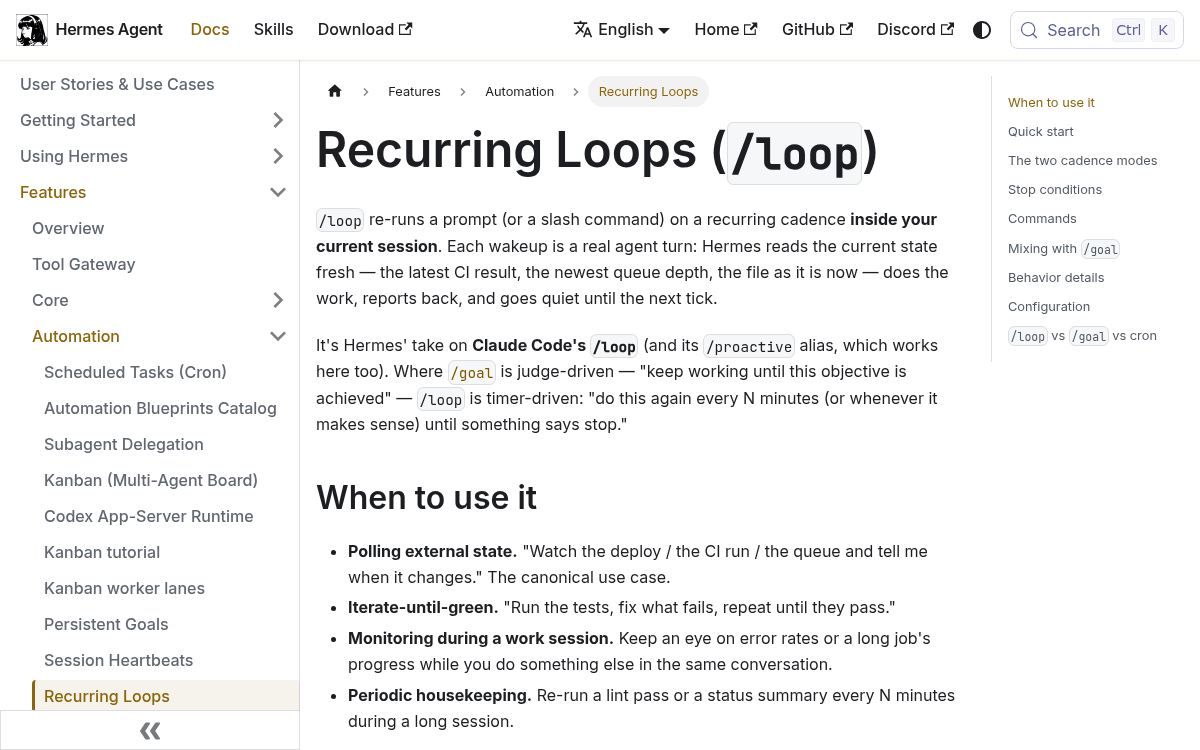
/loop re-runs a prompt (or another slash command) on a recurring cadence inside your current session. Each wakeup is a real agent turn: Hermes reads the current state fresh, does the work, reports back, and goes quiet until the next tick. Think of it as a lightweight polling loop you can spin up mid-conversation, without leaving the terminal or switching tools.
The basic syntax is straightforward:
# Fixed interval: check every 5 minutes
/loop 5m check the deploy status and tell me if it's live yet
# Loop another slash command
/loop 10m /recap
# Self-paced: Hermes decides the cadence
/loop keep an eye on the migration and summarize progress
Two modes, one command
The most interesting design choice is the self-paced mode. Omit the interval and the loop paces itself: it starts at the floor (1 minute by default), and while the agent's replies stop changing it backs off exponentially -- 2m, 4m, 8m, up to a ceiling of 15 minutes by default. The moment a reply differs from the last one, cadence snaps back to the floor. Change detection uses a local digest comparison that ignores timestamps, so idle waits cost nothing extra in compute.