



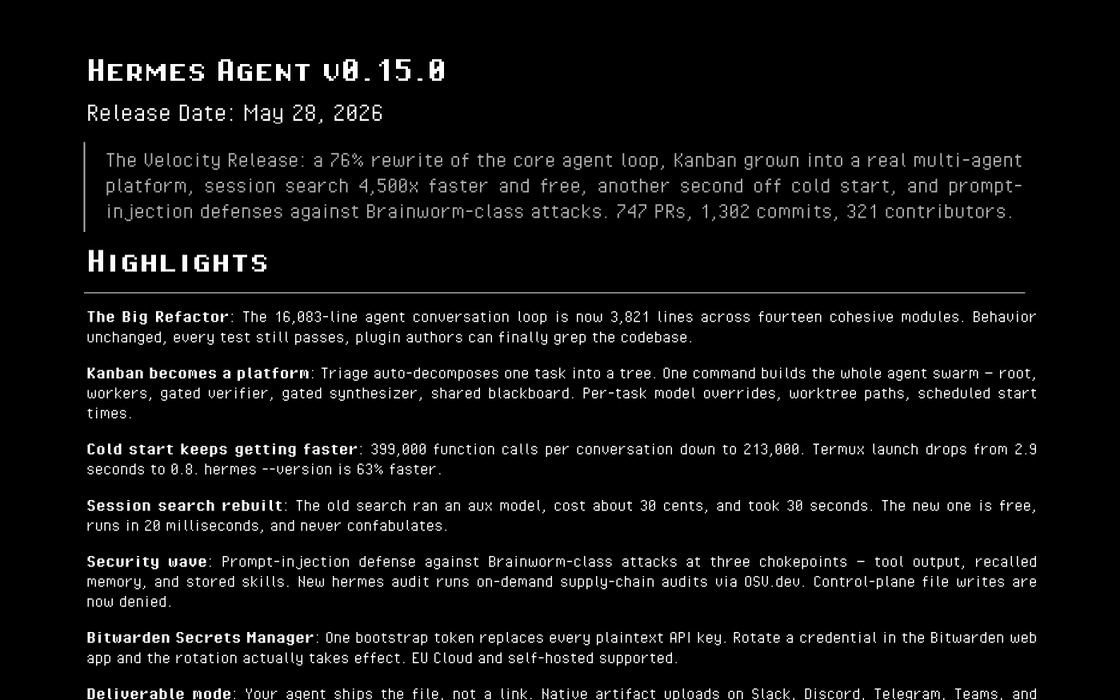
Hermes Agent v0.15.0, dubbed "The Velocity Release," is the biggest single update in the project's short but explosive history. Since v0.14.0, the release spans 1,302 commits, 747 merged PRs, 1,746 files changed, and 560+ issues closed, with 321 community contributors. For a project that went from launch to roughly 180,000 GitHub stars in about three months, this release is a statement: Nous Research is treating Hermes as serious infrastructure, not a demo.
The monolith falls
The centerpiece of this release is a refactor that has been a long time coming. The 16,083-line run_agent.py collapses to 3,821 lines (-76%) across 14 cohesive agent/* modules. That single file was the agent's entire conversation loop , the thing that runs on every single turn. At 16,000 lines, it was nearly impossible to grep, nearly impossible to contribute to, and took 90 seconds to load in most editors.
The refactor is behavior-preserving: every extraction keeps a thin forwarder on AIAgent, every test patch path still works, and every external caller stays compatible. But the downstream effects are real. The run_agent.py refactor is a maintainability win first , but it also unlocked the performance work that defines this release, and it's what made the new desktop app (shipped days later) architecturally feasible.
Speed, everywhere
The performance gains in v0.15.0 are specific and measurable, not vague claims. Four separate optimization passes landed:
- Cold start: Another second shaved off launch, 47% fewer per-conversation function calls, with
hermes --versionflipping the head-to-head benchmark against Codex CLI. Specifically, Termux cold start drops from 2.9s to 0.8s, andhermes --versionwall time drops 63% from 701ms to 258ms. - Per-turn overhead: Deferring the
openai._base_clientimport saves 240ms and 17MB on every CLI invocation. Adaptive subprocess polling cuts ~195ms per tool call, adding up to over a second per turn. - Memory search:
session_searchis roughly 4,500x faster (~90s to ~20ms) and now free. The old version called an auxiliary LLM to summarize sessions, costing ~$0.30 per call and sometimes hallucinating results when the right session wasn't even in the hit list.


Don't miss what's next in AI
Join 300,000+ engineers and researchers who get the signal, not the noise.
- Full access to in-depth AI research breakdowns
- Be the first to know what's trending before it hits mainstream
- Daily curated papers, repos, and industry moves