



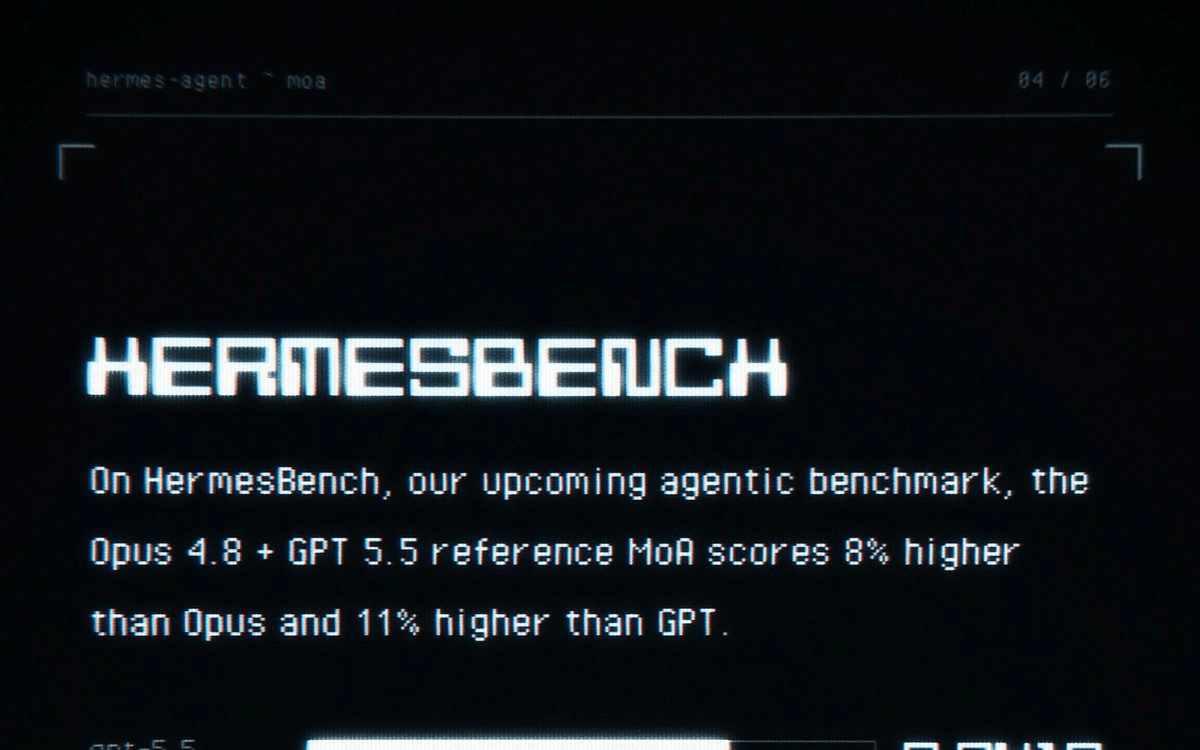
Hermes Agent, the open-source self-improving agent from Nous Research, just shipped a significant upgrade to its Mixture-of-Agents (MoA) system: named presets now appear as selectable virtual models inside the agent, making it trivially easy to combine multiple frontier LLMs into a single, more capable one. The headline claim is bold -- their MoA presets score 8% higher than Claude Opus 4.8 and 11% higher than GPT-5.5 on HermesBench, Nous' upcoming agentic benchmark.
The problem with frontier model access
The best models in the world are gated. Getting access to Claude Opus 4.8 requires Anthropic approval. GPT-5.5 is similarly restricted. Even when you do get access, you're betting everything on one model's strengths and blind spots. Hermes Agent's MoA feature is a direct answer to this: instead of waiting for access to a single gated model, you compose several publicly available ones into something that outperforms them.
What Mixture-of-Agents actually means
MoA is a technique formalized in a 2024 paper by Wang et al. It exploits a property of LLMs called collaborativeness -- the empirical observation that models produce higher-quality outputs when they can see what other models said first. The architecture has two roles:
- Reference models (proposers): Multiple LLMs independently answer the same prompt, each contributing their own perspective and strengths.
- Aggregator: A final model reads all the reference answers and synthesizes them into a single, higher-quality response.
The technique demonstrates that having multiple LLMs independently answer the same question, then using an aggregator model to synthesize their responses, consistently outperforms any single model. It exploits the collaborativeness property of LLMs -- their ability to improve responses when given other models' outputs as reference. The aggregator isn't just picking the best answer -- MoA outperforms an LLM-ranker baseline, suggesting that the aggregator performs sophisticated aggregation over all generated outputs.


Don't miss what's next in AI
Join 300,000+ engineers and researchers who get the signal, not the noise.
- Full access to in-depth AI research breakdowns
- Be the first to know what's trending before it hits mainstream
- Daily curated papers, repos, and industry moves