



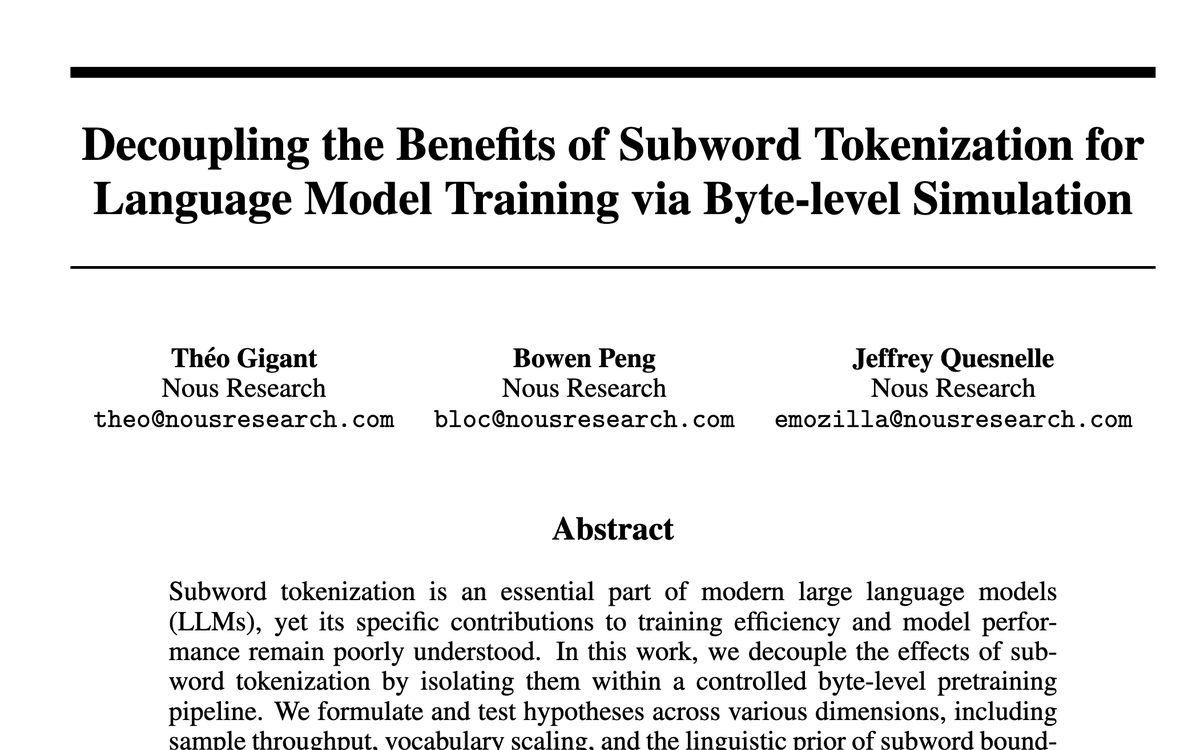
Byte-level language models have a compelling pitch: no tokenizer, no vocabulary, no language-specific preprocessing. But they keep losing to subword models in practice, and for years the field has treated the gap as a known fact without a precise explanation. Subword tokenization is an essential part of modern large language models, yet its specific contributions to training efficiency and model performance remain poorly understood. A new paper from Théo Gigant, Bowen Peng, and Jeffrey Quesnelle , all at Nous Research , finally puts that intuition under a microscope.
The authors decouple the effects of subword tokenization by isolating them within a controlled byte-level pretraining pipeline, formulating and testing hypotheses across dimensions including sample throughput, vocabulary scaling, and the linguistic prior of subword boundaries. The result is the clearest causal account yet of what subword tokenization is actually doing for you.
Seven suspects, one lineup
The paper, titled "Decoupling the Benefits of Subword Tokenization for Language Model Training via Byte-level Simulation", frames the problem as a controlled experiment. Rather than comparing a byte-level model to a subword model and calling it a day, the authors inject each suspected advantage of subword tokenization , one at a time , into a byte-level pipeline and measure the change in validation loss.
The seven hypotheses they test fall into three buckets:
- Computational efficiency: Larger vocabulary parameters give the model more capacity (H1); subword compression means the model sees ~4x more raw text per gradient step at equal FLOPs (H2)
- Structural priors: Subword end-boundaries leak future bytes, making prediction easier (H3); subword start-boundaries act as a morphological inductive bias (H4); subword positional distances align attention with semantically meaningful units (H5)
- Optimization objective: Minimizing cross-entropy per subword is a better proxy than per-byte (H6); predicting the next subword is a form of multi-token prediction that improves representations (H7)


Don't miss what's next in AI
Join 300,000+ engineers and researchers who get the signal, not the noise.
- Full access to in-depth AI research breakdowns
- Be the first to know what's trending before it hits mainstream
- Daily curated papers, repos, and industry moves