
Moonshot AI's Kimi-K2.7-Code Beats Rivals With 30% Less Overthinking

Moonshot AI open-sources Kimi-K2.7-Code with 21.8% coding gains and 30% fewer reasoning tokens than K2.6

·
·
Moonshot AI's Kimi-K2.7-Code Beats Rivals With 30% Less Overthinking
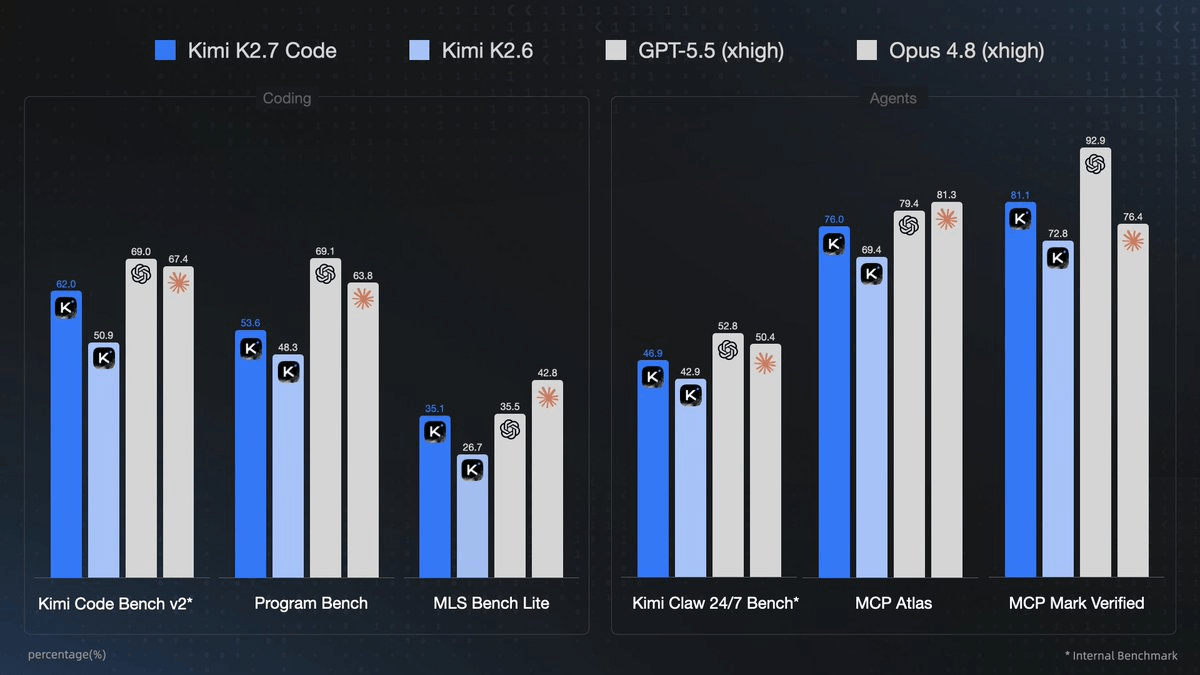
  • Kimi-K2.7-Code released and open-sourced: Moonshot AI's new coding-specialized model posts +21.8% on Kimi Code Bench v2, +11.0% on Program Bench, and +31.5% on MLS Bench Lite vs K2.6.
  • 30% fewer reasoning tokens: The model is explicitly trained to reduce overthinking, cutting reasoning-token usage by 30% compared to K2.6, lowering real-world costs on coding tasks.
  • Same 1T MoE architecture: Built on the same 1-trillion-parameter Mixture-of-Experts base as K2.6, with 32B active parameters per token and native INT4 quantization.
  • Available now via API and Kimi Code: Accessible through the Kimi API (OpenAI-compatible) and the Kimi Code CLI, which integrates with VSCode, Cursor, and Zed.
  • Kimi Code Beta Program launched: Apply at kimi.com/code/beta for early access to upcoming models and features before public release.
  • 6x High-Speed Mode coming soon: A fast inference mode is teased, which would significantly improve latency for interactive coding workflows.

Moonshot AI just shipped Kimi-K2.7-Code, a coding-specialized update to its K2 model family, and open-sourced the weights on the same day. The headline numbers are hard to ignore: +21.8% on Kimi Code Bench v2, +11.0% on Program Bench, and +31.5% on MLS Bench Lite versus K2.6. But the more interesting story is what the model does less of: it uses 30% fewer reasoning tokens to get there.

The overthinking problem, solved

Reasoning models have a well-known failure mode: they burn enormous amounts of compute spinning through unnecessary thinking steps before producing an answer. Ethan Mollick's Lem Test had K2.6 generating a 74-page thinking trace to produce an okay-ish answer, and Artificial Analysis measured K2.6 burning roughly 160M reasoning tokens to run their Intelligence Index, versus ~110M for GPT-5.4. K2.7-Code directly attacks this. Reasoning efficiency is one of its headline claims: less overthinking, with 30% lower reasoning-token usage compared to K2.6. In practice, this means faster completions and lower API costs on reasoning-heavy coding tasks.

This matters because per-token cheap doesn't equal per-task cheap. On reasoning-heavy workloads, headline savings can compress significantly, and the real number has to be calculated against actual workflow shape, not the rate card. A model that reasons more efficiently is a model that's actually cheaper to run in production.

What's under the hood

K2.7-Code sits on top of the same 1-trillion-parameter Mixture-of-Experts (MoE) architecture that has defined the K2 family since the beginning. MoE means the model has a huge total parameter count but only activates a fraction of them per token during inference. The architecture uses 32 billion active parameters per token, with 384 experts per layer (8 routed plus 1 shared), Multi-head Latent Attention to compress the KV cache, SwiGLU activation, and native INT4 quantization. Inference cost stays at the 32B level while model capacity is 1T.

The K2.7-Code release is a coding-focused fine-tune rather than a full architectural overhaul. The architecture is unchanged from K2.5 onward, with the difference being in post-training: more training compute applied to long-horizon stability, instruction following, and task-specific performance. Think of it as a specialized checkpoint optimized for the exact workloads that coding agents run into in production.

The benchmarks, unpacked

Three benchmarks are cited in the release. Here's what they actually measure:

  • Kimi Code Bench v2: Moonshot's internal coding benchmark covering diverse end-to-end tasks, from building to debugging, refactoring, testing, and scripting, across multiple programming languages. K2.7-Code scores +21.8% over K2.6.
  • Program Bench: A programming-focused evaluation measuring code generation quality across a range of task types. K2.7-Code improves +11.0% over K2.6.
  • MLS Bench Lite: A multi-language software benchmark. K2.7-Code gains +31.5% over K2.6 here, the largest jump of the three.

These are significant jumps for a single model iteration. For context, benchmark improvements from K2.5 to K2.6 were concrete but incremental: SWE-Bench Pro moved from 50.7% to 58.6%, Terminal-Bench 2.0 from 50.8% to 66.7%. K2.7-Code's gains on its target benchmarks are steeper, suggesting the coding-specific post-training is paying off.

Where the K2 family still has limits

K2.7-Code is a coding specialist, not a universal frontier model. The broader K2.6 baseline already had known gaps worth keeping in mind:

  • K2.6 lags GPT-5.4 on GPQA-Diamond (90.5% vs 92.8%) and AIME 2026 (96.4% vs 99.2%). Pure mathematical reasoning remains a weak point.
  • Its strongest category is Coding (#8 globally), while its weakest is Multimodal and Grounded tasks (#29).
  • For ambiguous specs, deep multi-file reasoning, and sustained multi-agent coordination, Claude Opus 4.7 still wins independent comparisons.

K2.7-Code doubles down on the coding strength and doesn't claim to fix the reasoning or multimodal gaps. That's a reasonable trade-off for a model explicitly named after its use case.

How to use it today

Access comes through two main paths. The API is available at platform.moonshot.ai with an OpenAI/Anthropic-compatible interface. The model is also the default backend for Kimi Code, the CLI tool that integrates with VSCode, Cursor, Zed, and other IDEs. Kimi Code works in your terminal and can be integrated with various IDEs including VSCode, Cursor, and Zed. It is open-sourced and supports images and videos as inputs.

Calling K2.7-Code via the API is a straightforward swap if you're already using the OpenAI SDK:

from openai import OpenAI
client = OpenAI(
    api_key="YOUR_KIMI_API_KEY",
    base_url="https://api.moonshot.ai/v1"
)
response = client.chat.completions.create(
    model="kimi-k2.7-code",
    messages=[
        {"role": "system", "content": "You are a coding assistant."},
        {"role": "user", "content": "Refactor this Python function for performance..."}
    ],
    temperature=1.0  # recommended for thinking mode
)
print(response.choices[0].message.content)

For pricing, with K2.6 at $0.95/$4.00 per million tokens, light use runs $5-40/month, medium use $40-200/month, and heavy use $200-800/month. K2.7-Code pricing is expected to be similar, and the 30% reduction in reasoning tokens means real-world costs could land lower than the rate card suggests for coding-heavy workloads. Cached input is billed at $0.16/M on K2.6, roughly 80-85% off cache-miss input rates, with no configuration required.

The Beta Program and what's coming

Alongside the model release, Moonshot is launching the Kimi Code Beta Program, an early-access tier for trying upcoming models and features before public release. A 6x High-Speed Mode is also teased as coming soon, which would meaningfully change the latency profile for interactive coding workflows.

Community reaction has been positive. Many users expressed excitement toward Moonshot AI for open-sourcing Kimi-K2.7-Code because of its major coding gains, efficiency, and benchmarks. One reaction on X called it "insane," noting that less overthinking plus better long-horizon performance equals an actual usable coding agent. The pricing question came up quickly too, with users noting the input cost difference from K2.6 is minimal.

The bigger picture

Moonshot has been shipping model updates at a pace that's unusual even by 2026 standards: K2.5 in January, K2.6 in April, and now K2.7-Code in June. Each release has targeted a specific weakness. What this tells the field is that the moat for coding agents is no longer the model. It is the harness. Cursor, Claude Code, and Codex are not winning because they have better models; they are winning because they have better tooling around the model. K2.7-Code is Moonshot's answer to that gap: close the model quality delta while keeping the open-weight, low-cost advantage that makes the K2 family compelling in the first place.

For teams running coding agents in production, the combination of improved benchmark scores and reduced reasoning-token burn makes K2.7-Code worth testing against your existing eval suite this week. The weights are out, the API is live, and the cost of running a comparison is low.

Comments

avatar