

Microsoft's MAI-Code-1-Flash Beats Claude Haiku With 60% Fewer Tokens
Microsoft's first in-house coding model beats Claude Haiku 4.5 on all benchmarks while using up to 60% fewer tokens, now live in GitHub Copilot for VS Code
- New model live now: MAI-Code-1-Flash, Microsoft's first in-house coding model, is rolling out to GitHub Copilot individual users in VS Code.
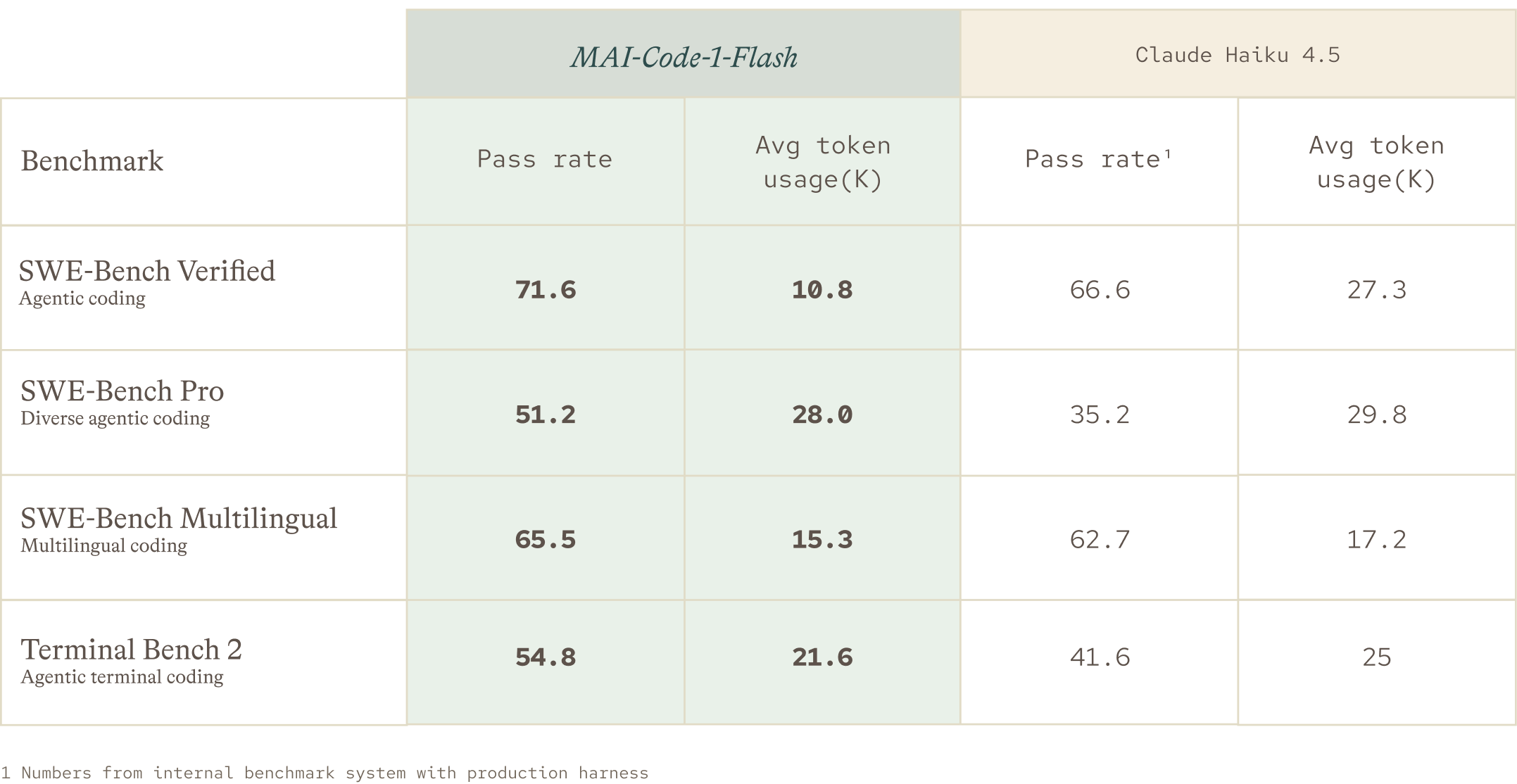
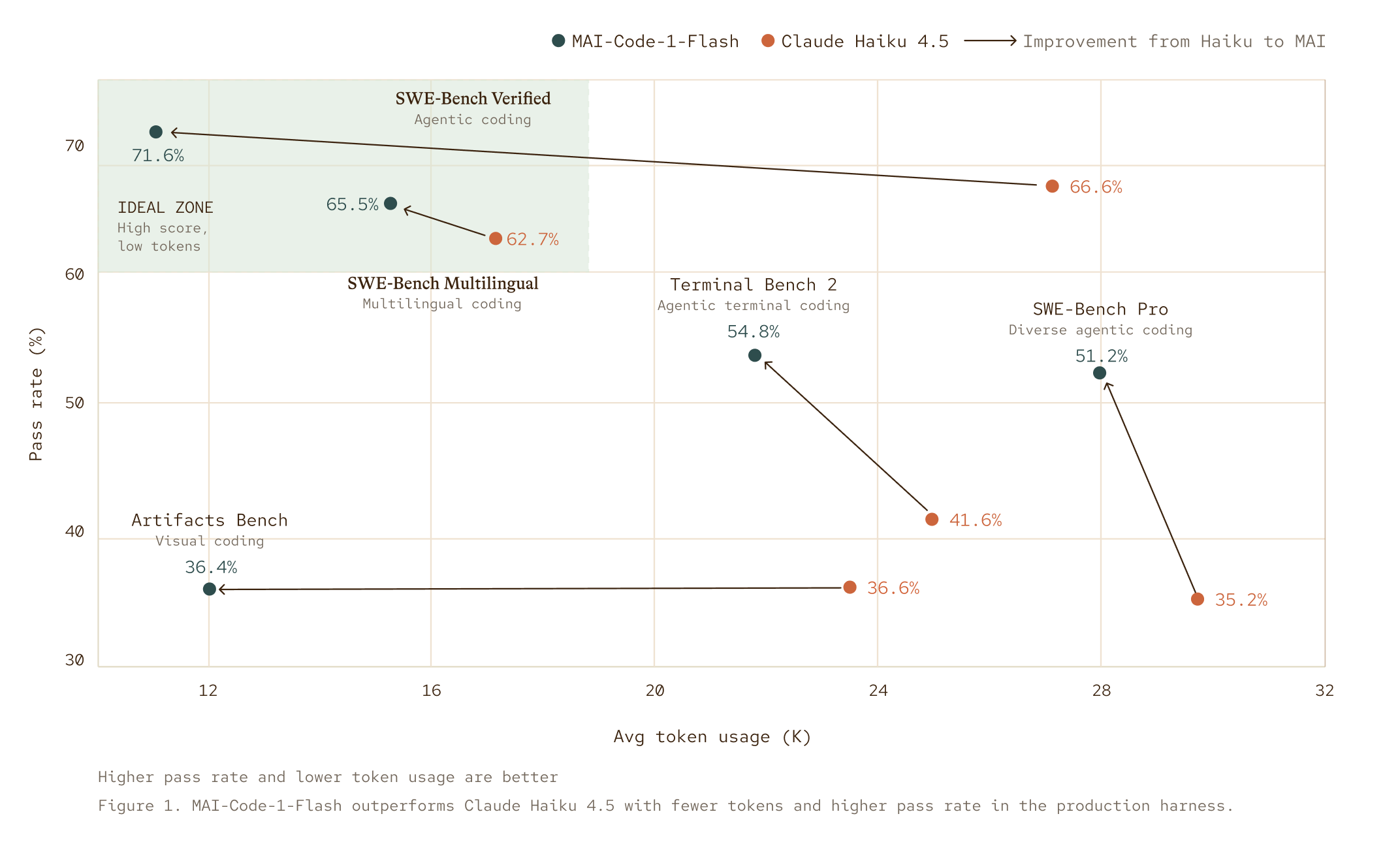
- Beats Claude Haiku 4.5: Outperforms it on all 4 core coding benchmarks, with a +16-point lead on SWE-Bench Pro (51.2% vs. 35.2%).
- 60% fewer tokens: Adaptive solution length control lets it solve harder problems with up to 60% fewer tokens, lowering cost and latency.
- Trained inside Copilot: Uniquely trained on GitHub Copilot's production harness using 2M+ synthetic agentic tasks and RL across 150K+ environments.
- Access: Free, Pro, Pro+, and Max Copilot plans via VS Code model picker; also available via Azure Foundry and GitHub Models API.
- Strategic shift: Part of Microsoft's 7-model MAI family launched at Build 2026, signaling reduced dependence on OpenAI after renegotiating their exclusivity deal.
Microsoft just shipped its first homegrown coding model, and it's already live inside GitHub Copilot. MAI-Code-1-Flash debuted at Build 2026 as part of a seven-model MAI family, and it marks a genuine strategic shift: Microsoft is no longer just an OpenAI reseller. This is a model Microsoft built, owns, and can price on its own terms.
The model that matters most for your daily workflow
MAI-Code-1-Flash is a 5-billion-parameter model purpose-built for coding tasks inside GitHub Copilot. The "Flash" suffix is the giveaway on intent: this is a latency- and cost-optimized model, not a frontier flagship. But its benchmark numbers punch well above that weight class. MAI-Code-1-Flash outperforms Claude Haiku 4.5 across all four core coding benchmarks tested, including a 16-point lead on SWE-Bench Pro (51.2% vs. 35.2%).
Microsoft trained it from the ground up on clean, traceable, and enterprise-grade data, without distillation from third-party models. That's not just a legal talking point. It means the model's outputs carry a cleaner IP provenance story for enterprise buyers who care about where training data came from.
Trained inside the tool, not just for it
The most important design decision here isn't the architecture , it's where training happened. Most coding models are trained on code datasets and then evaluated against Copilot-style workflows. MAI-Code-1-Flash was trained inside GitHub Copilot's production harness, meaning the training distribution matches the exact patterns of real developer interactions, not academic code datasets.
That means the model learned to interact with the surrounding tools and systems that agentic coding actually requires: invoking commands, reading repository context, and working through multi-step tasks the way Copilot orchestrates them. During training, Microsoft evaluated checkpoints across core software engineering tasks, repository question answering, refactoring, and telemetry-grounded tasks adapted from real GitHub Copilot usage.
The training pipeline itself is multi-stage. It starts from MAI-Thinking-1's mid-training checkpoint, applies a lightweight supervised fine-tuning stage on curated instruction-following and agentic task data, then runs an additional "mid2" training phase using approximately 2 million diverse synthetic agentic tasks organized into two progressive stages from simpler to more complex scenarios, followed by a final large-scale reinforcement learning stage conducted on diverse agentic tasks spanning more than 150,000 environments.
The efficiency story is the real headline
MAI-Code-1-Flash was trained with what Microsoft calls adaptive solution length control. The model adjusts the depth of its response to the task: it stays concise for simple requests and spends more reasoning budget when a problem needs deeper analysis or broader code changes. Think of it as a model that doesn't waste tokens explaining what a for-loop is when you ask it to fix a typo.
The efficiency gains are concrete:
- The model can solve harder coding tasks with up to 60% fewer tokens on SWE-Bench Verified.
- It achieves a +28.9-point lead on IF Bench for precise instruction following.
- In the new token-based billing in GitHub Copilot, MAI-Code-1-Flash is priced cheaper than Claude Haiku 4.5.
- That efficiency compounds in three ways: lower latency, lower cost, and smoother interactive workflows.
Where it shines, and where it doesn't
The benchmark picture is strong across the board. MAI-Code-1-Flash comes out ahead on every benchmark in the table, with the widest margin on IF Bench precise instruction following (+28.9) and the narrowest on rubric-based Advanced IF (+14.5). It also holds up on reasoning tasks beyond pure coding. MAI-Code-1-Flash also outperforms Claude Haiku 4.5 on core reasoning capabilities in math, science, and visual generation coding.
Microsoft also built a custom adversarial benchmark to test whether the model actually reasons or just pattern-matches. They built a 186-question, 34-category benchmark around adversarial traps like inverted classics, impossible tasks, and underdetermined scenarios. MAI-Code-1-Flash reached 85.8% adjusted accuracy, with especially strong performance in reasoning, instruction-following, and recognizing impossible problems. The honest caveat: core adversarial categories like Einstellung traps remained below 50% accuracy. Einstellung traps are problems where a known solution pattern blocks you from finding a better one , a real failure mode for production code.
Some developers note the chosen benchmarks favor Microsoft, and MAI-Code-1-Flash's behavior on real, complex projects still needs broad real-world validation. Microsoft has published a preprint describing the evaluation methodology, but full reproduction of the results by independent labs has not yet occurred, leaving those benchmark claims open to challenge until confirmed externally.
How to get it right now
MAI-Code-1-Flash is now rolling out to approximately 10% of individual users as a starting point, and users who select Auto in the VS Code model picker may get routed to the model. MAI-Code-1-Flash is beginning to roll out to Copilot Free, Pro, Pro+, and Max plans. No additional setup is required.
If you want to use it explicitly:
- Open VS Code with GitHub Copilot installed
- Open the Copilot chat panel
- Click the model picker dropdown
- Select
MAI-Code-1-Flashdirectly, or leave it onAutoand let Copilot route to it
For teams building their own coding-agent infrastructure separately from Copilot, MAI-Code-1-Flash is available in Azure Foundry and GitHub Models as an API endpoint. Azure AI Foundry pricing for the broader MAI model family exists, but specific per-token rates for MAI-Code-1-Flash were not published at launch. GitHub Models provides prototyping access without an Azure subscription, available now with a GitHub account.
The bigger picture: Microsoft's OpenAI exit ramp
In April 2026, Microsoft renegotiated its OpenAI deal, ending exclusivity and revenue-sharing arrangements. MAI-Code-1-Flash is the first visible output of that strategic pivot. Multiple outlets reported these in-house models are a key step for Microsoft to reduce reliance on third-party providers and to offer lower-cost inference on Azure. In other words, Microsoft no longer wants to be just OpenAI's distribution channel , it wants to own its cost structure and technical direction.
The community reaction on GitHub Discussions has been eager but pointed. Users are asking for Business and Enterprise plan availability (currently limited to individual plans), API access on OpenRouter, and offline options. One developer put it bluntly: "as far as releases go this one is making it rather difficult to even try the model." The rollout is gradual, and the API story is still incomplete.
What's clear is that the model's design philosophy represents a meaningful shift in how to think about coding assistants. For most developers, the MAI release that changes day-to-day work isn't the reasoning flagship , it's the coding model. MAI-Code-1-Flash is a 5-billion-parameter model trained directly on GitHub Copilot's production tool harnesses rather than academic benchmarks, optimized for the actual edit-run-fix loop developers use rather than for leaderboard problems. If that training philosophy holds up in the wild, the assumption that bigger always means better for coding assistants deserves a second look.
Comments
