



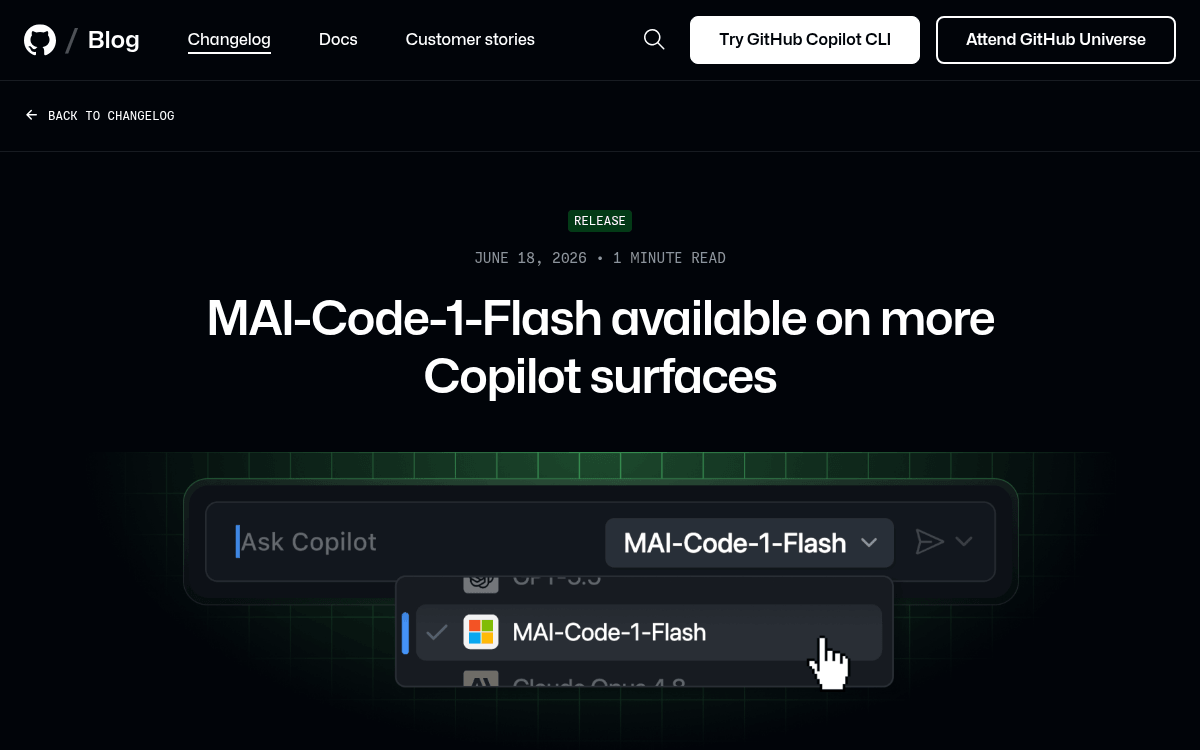
MAI-Code-1-Flash, Microsoft's first homegrown coding model, just got a lot more accessible. Originally launched at Build 2026 with VS Code support only, it now runs across nearly every surface GitHub Copilot touches. If you use Copilot in JetBrains, Xcode, Eclipse, GitHub Mobile, Copilot CLI, or Copilot Chat on GitHub, the model is now available to you.
What makes this model different
Microsoft trained MAI-Code-1-Flash from the ground up on clean, traceable, and enterprise-grade data, without distillation from third-party models. That last part matters: this is not a repackaged OpenAI model. Strategically, Microsoft now has a homegrown coding stack that reduces its reliance on OpenAI and undercuts frontier models on cost.
It is a 5-billion-parameter model trained directly on Copilot production workflows, optimized for the tasks that dominate a developer's day: inline edits, quick refactors, and single-file fixes. The architecture is a sparse Mixture-of-Experts model with 137 billion total parameters and a 256,000-token context window. Because it is sparse MoE, only a fraction of those 137B parameters activate per token, which is how Microsoft hits its efficiency target while keeping a large total capacity.
Trained inside the tool, not just for it
Most coding models are trained on general code, then evaluated against benchmarks, then deployed to tools. MAI-Code-1-Flash inverts that: it was trained inside GitHub Copilot's production harness, not just evaluated against it. The model was trained directly with GitHub Copilot harnesses used in production, allowing it to learn how to interact with surrounding tools and systems in agentic coding tasks, making it uniquely well suited to real-world Copilot workflows.


Don't miss what's next in AI
Join 300,000+ engineers and researchers who get the signal, not the noise.
- Full access to in-depth AI research breakdowns
- Be the first to know what's trending before it hits mainstream
- Daily curated papers, repos, and industry moves