



For the millions of people who have lost the ability to speak or move after a stroke, ALS, or locked-in syndrome, the only path to communication today runs through brain surgery. Implanted electrode arrays can restore near-natural speech, but they require neurosurgery, carry infection risks, and are nearly impossible to scale to a broad patient population. Brain2Qwerty v2, released today by Meta AI, is the strongest evidence yet that this tradeoff may not be permanent.
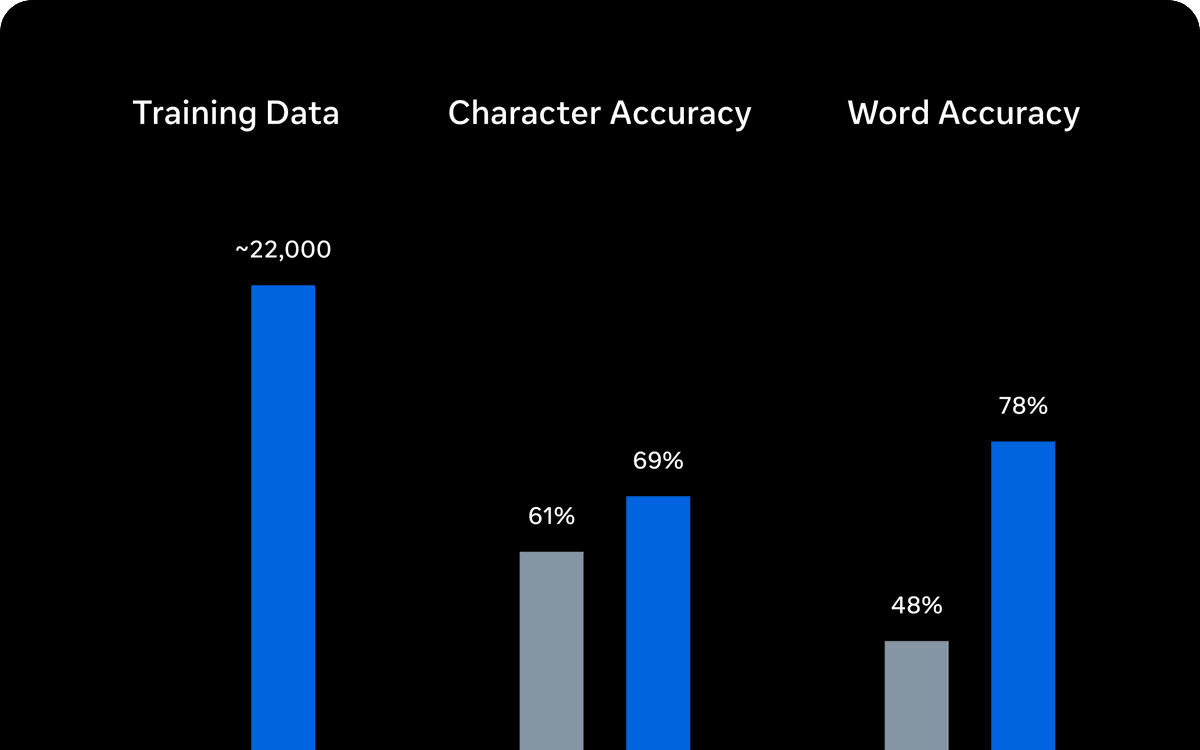
Brain2Qwerty v2 is the highest-performing end-to-end pipeline capable of real-time sentence decoding from non-invasive brain recordings, approaching levels of accuracy previously exclusive to techniques that require brain surgery. The v1 paper was simultaneously published in Nature Neuroscience, and Meta is releasing the full training code for both versions alongside a public dataset from their partner, the Basque Center on Cognition, Brain and Language (BCBL).
The problem with reading minds without a scalpel
Brain-computer interfaces (BCIs) that require implanted electrodes have achieved remarkable results. State-of-the-art invasive BCIs achieve below 2% word error rate for typing and below 6% character error rate for handwriting. Despite these breakthroughs, the invasive nature of intracortical implants is a challenge for large-scale clinical translation. Non-invasive alternatives like EEG have historically struggled with a poor signal-to-noise ratio, limiting them to simple, highly-constrained tasks that are impractical for real patients.
Magnetoencephalography (MEG) , a technique that measures the tiny magnetic fields produced by electrical currents in neurons , offers a middle ground. It has much better signal quality than EEG without requiring any implant. Invasive procedures like stereotactic electroencephalography and electrocorticography have shown that a neuroprosthesis feeding signals to an AI decoder can restore communication, but they're difficult to scale. Meta's non-invasive approach can help bridge that gap.
From characters to meaning: what changed in v2
The original Brain2Qwerty (v1) decoded brain signals at the character level, essentially trying to figure out which key a person pressed based on their neural activity. V2 is a fundamentally different beast. Brain2Qwerty v2 is the first architecture that jointly trains the decoding of characters, words, and sentences. It leverages character, word, and sentence-level representations to achieve an average word error rate (WER) of 39%.


Don't miss what's next in AI
Join 300,000+ engineers and researchers who get the signal, not the noise.
- Full access to in-depth AI research breakdowns
- Be the first to know what's trending before it hits mainstream
- Daily curated papers, repos, and industry moves