
Krea 2 Beats OpenAI and Google Rivals at $0.03 per Image
Krea's first fully in-house image model lands at #6 globally, beating models twice its price with a creativity API that treats aesthetics as a first-class parameter
Takeaways
- Krea 2 debuts at #6 on the Artificial Analysis Text-to-Image Leaderboard, the top spot for any independent research lab.
- First fully in-house model: Unlike Krea 1, which was built with Black Forest Labs on FLUX, Krea 2 is trained entirely from scratch by Krea.
- Two variants: Medium ($0.03/image) excels at illustration and expressive styles; Large ($0.06/image) targets photorealism and raw aesthetics.
- Unique API controls: A tunable
creativityparameter (raw/low/medium/high), multi-image style transfer with per-reference weighting, and moodboard support are all first-class API features. - Krea 2 Turbo launched days later, generating images in 2 seconds with full support for style references, moodboards, and LoRAs.
- Open-source hinted: Krea has signaled an open-source release is in progress, which could further disrupt the image generation market.
Krea 2 just made a statement. The creative AI platform's first fully homegrown image model debuted at #6 on the Artificial Analysis Text-to-Image Leaderboard, sitting just behind models from OpenAI, Google, and NVIDIA. More surprisingly, the smaller and cheaper of its two variants, Krea 2 Medium, outranked the larger Krea 2 Large in blind user voting. For a company that previously built its image model in collaboration with Black Forest Labs, this is a meaningful leap.
From collaboration to independence
Krea 1 was created as a research collaboration between Krea and Black Forest Labs. FLUX.1 Krea [dev] was the open-weights version of that model, offering strong performance with highly distinctive aesthetics and exceptional realism. Krea 2 is a different story entirely. It is Krea's first foundation image model, trained completely from scratch to give users full control over the look, feel, and creative direction of every image they create. The company is no longer building on someone else's base weights.
Most image models are good at understanding what you want in an image. Krea 2 is built around the second part: how you want it to look. That framing is central to everything about this release. Where other models optimize for prompt fidelity and photorealism, Krea 2 is explicitly designed around aesthetics, style consistency, and creative range.
Two models, one winner
Krea 2 ships in two variants with meaningfully different characters:
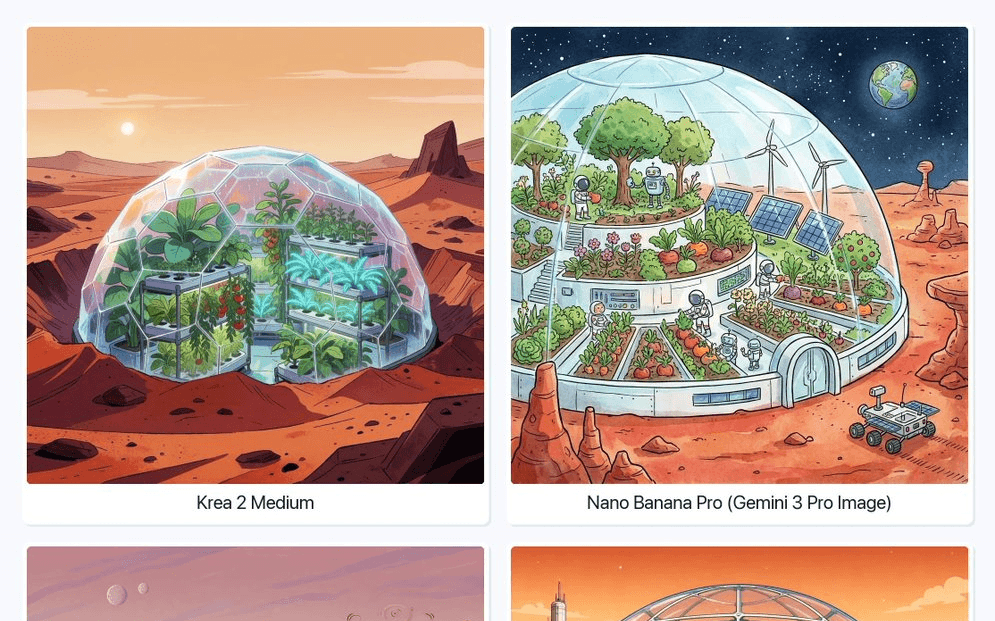
- Krea 2 Medium: A smaller, faster, and more cost-efficient model with extensive post-training applied. This makes its outputs especially stable and consistent across generations. Medium is particularly strong on illustration, anime, painting, and other expressive or artistic styles.
- Krea 2 Large: More than twice the size of Medium, with a softer post-training applied, which gives its outputs a rawer, more textured, and flexible character. Large is the more powerful model overall. It handles expressive and artistic styles well, and shines on photorealism and raw looks like motion blurs, grains, or low dynamic ranges.
The twist is that Medium beat Large in the arena. Post-training here refers to the fine-tuning phase after a model's base training, where human feedback and curated data are used to shape the model's outputs. Krea applied heavier post-training to Medium, which makes it more predictable and consistent, qualities that users apparently reward in blind comparisons. Krea 2 is now listed on Artificial Analysis, ranking as the #1 image model from an independent research lab and #6 globally on the text-to-image leaderboard.
The API is the product
Starting with the API launch, developers can access Krea 2 through API partners such as Fal, Comfy, or Runware. The model exposes a set of controls that go well beyond a simple text prompt:
- Style transfer: Pass in one or more reference images and Krea 2 extracts the visual style and applies it to your output. You control how strongly each reference influences the result using a per-reference strength parameter. Up to 10 reference images are supported simultaneously.
- Creativity parameter:
The
creativityparameter controls how far the model expands on what you wrote. When your prompt is short or vague, the model fills in missing pieces, including style, composition, camera angle, and color palette, and creativity decides how much liberty it takes. The four settings areraw,low,medium, andhigh. - Moodboards: Pass in an entire moodboard of dozens of images and Krea 2 will understand the overall creative direction, producing outputs that align with it.
Here is a minimal example of calling the API with style transfer in Python:
import requests, os
API_TOKEN = os.environ["KREA_API_TOKEN"]
BASE = "https://api.krea.ai"
# Submit generation job
resp = requests.post(
    f"{BASE}/generate/image/krea/krea-2/medium",
    headers={"Authorization": f"Bearer {API_TOKEN}"},
    json={
        "prompt": "a cinematic product shot of a glass lamp",
        "aspect_ratio": "4:5",
        "resolution": "1K",
        "creativity": "low",
        "image_style_references": [{"url": "https://...", "strength": 0.6}]
    }
)
job_id = resp.json()["job_id"]
# Poll for result
import time
while True:
    job = requests.get(f"{BASE}/jobs/{job_id}",
        headers={"Authorization": f"Bearer {API_TOKEN}"}).json()
    if job["status"] == "completed":
        print(job["result"]["urls"])
        break
    time.sleep(3)
Pricing that undercuts the competition
Krea is pricing aggressively. According to the official API launch post, the per-image costs are:
| Model | Text-to-image | With Style References | With Moodboards |
|---|---|---|---|
| Krea 2 Medium | $0.030 | $0.035 | $0.040 |
| Krea 2 Large | $0.060 | $0.065 | $0.070 |
At $30 per 1,000 images, Medium undercuts comparable models significantly. Nano Banana Pro runs $134 per 1,000 images and grok-imagine-image-quality costs $50 per 1,000 images. The style transfer and moodboard features add a flat $5 per 1,000 images, and combining both does not stack the surcharge.
Speed as a feature
Krea is not just competing on quality. K2 generates outputs in 15 seconds or less, a fraction of what it takes other top models, allowing you to stay in your creative flow. And the company moved even faster after launch. Just days after the API launch, Krea introduced Krea 2 Turbo, which generates high-quality images in just 2 seconds, compatible with style references, moodboards, and LoRAs. LoRAs (Low-Rank Adaptation) are lightweight fine-tuning adapters that let you inject a specific style or subject into a model without retraining it from scratch. Krea 2 LoRAs are now available to everyone, letting users create and use custom LoRA styles with Krea 2 directly in Krea.
Who wins and who should pay attention
Krea builds AI tools for creatives, working closely with teams across creative studios, marketing and advertising agencies, fashion, gaming, and architecture. Those are exactly the users who care most about style consistency across batches, which is where Krea 2's moodboard and style transfer system has a real edge. Style references and moodboards keep outputs on-brand across large batches without manual correction.
The competitive pressure lands squarely on mid-tier image APIs. Models like FLUX.1 [pro] and Ideogram 2a now face a rival that is cheaper, faster, and backed by a leaderboard ranking that validates quality. For OpenAI and Google, the gap is still wide, GPT Image 2 holds the top spot with an Elo of 1340 versus Krea 2 Medium's #6 position, but Krea is the first independent lab to crack the top tier.
Krea claims over 30 million users across 191 countries, and its investor list includes a16z, Google Gradient, and Pebblebed. With a Turbo variant already out, LoRA support live, and open-source hinted at on the roadmap, open-source is cooking and coming soon. The model family is moving fast, and the leaderboard position gives it the credibility to compete for serious API workloads, not just consumer creative apps.