



Frontier AI labs have a quiet advantage: their models are trained to use their own tools. Claude is trained on Claude Code. GPT-5.5 is optimized for Codex. The model and the harness are tuned together, and the performance gains are real. Open-source developers, working with any model and any framework, haven't had an equivalent. OpenEnv is the project trying to close that gap, and it just got a lot more serious.
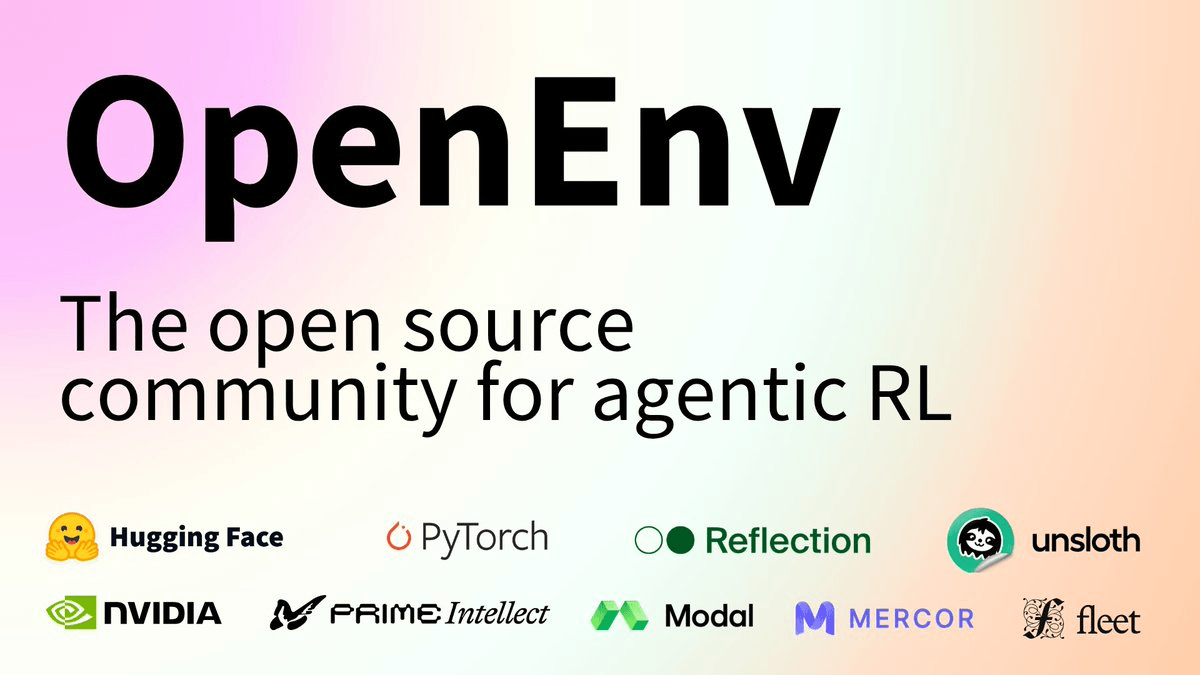
OpenEnv is a tool for creating agentic execution environments like terminals, browsers, or anything an agent can interact with. The project has now formalized its governance with a broad industry coalition. Starting today, OpenEnv will be coordinated by a committee that includes Meta-PyTorch, Reflection, Unsloth, Modal, Prime Intellect, NVIDIA, Mercor, Fleet AI, and Hugging Face, and the project now lives at huggingface/OpenEnv.
Why the open-source RL stack needed this
The reinforcement learning community has long struggled with a fundamental infrastructure problem: every research group and company builds their own execution environments from scratch, meaning researchers spend significant time on infrastructure rather than algorithms, and sharing work requires substantial integration effort.
While OpenAI Gym and Gymnasium standardized the interface for simulated environments, production RL training for modern agents requires something different: secure, isolated execution spaces that can run arbitrary code, interact with external systems, and scale across infrastructure. OpenEnv is the answer to that gap.
OpenEnv is supported and adopted by organizations including PyTorch Foundation, vLLM, SkyRL (UCB), Lightning AI, Axolotl AI, Stanford Scaling Intelligence Lab, Mithril, OpenMined, Scale AI, Patronus AI, Surge AI, and others.


Don't miss what's next in AI
Join 300,000+ engineers and researchers who get the signal, not the noise.
- Full access to in-depth AI research breakdowns
- Be the first to know what's trending before it hits mainstream
- Daily curated papers, repos, and industry moves