



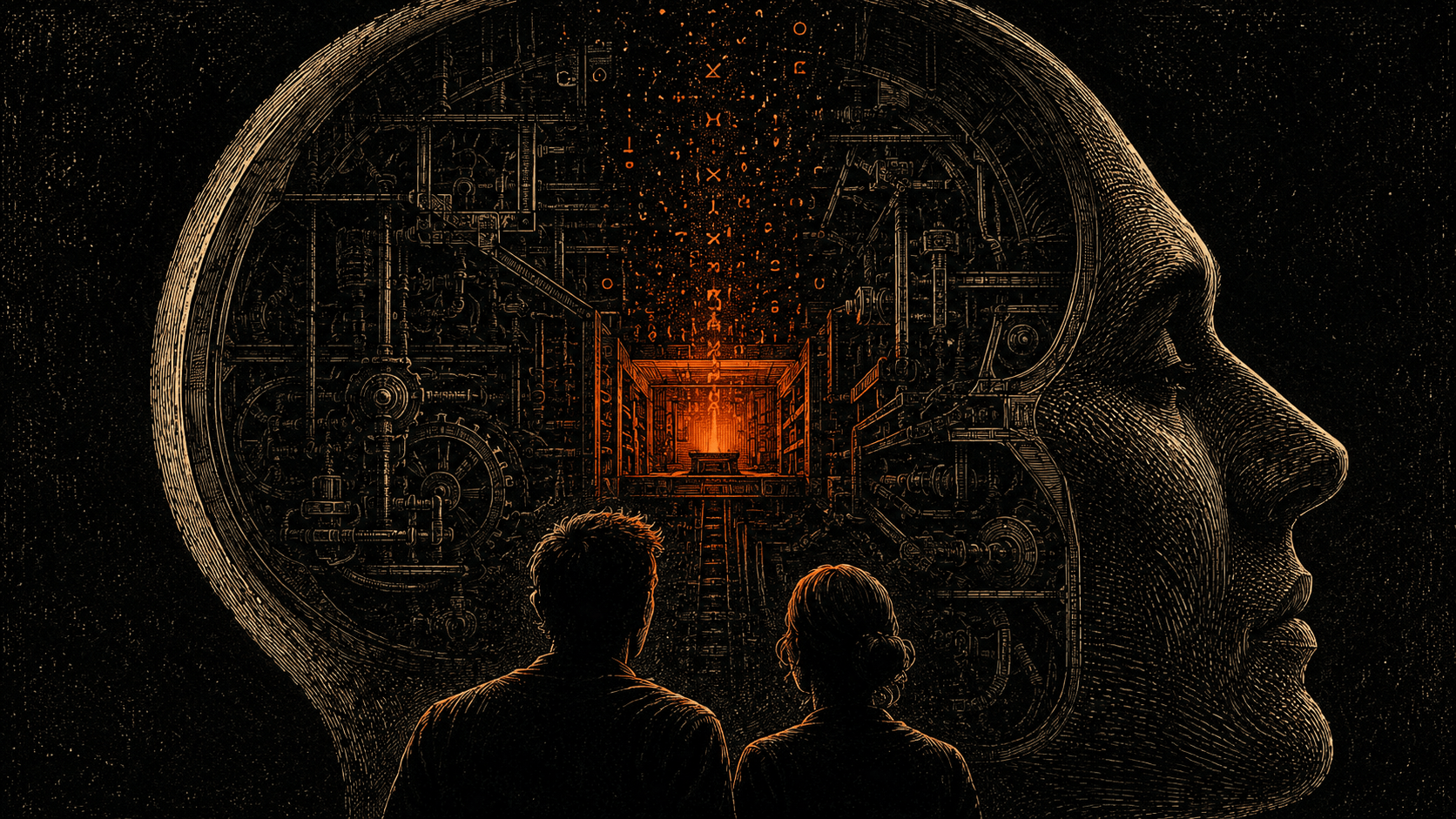
In ~6 mins: the one-matrix-per-layer lens Anthropic open-sourced, the few-dozen-concept "J-space" it reads, the swap test that flips a model's answer, the eval-awareness ablation that turned a 0% blackmail rate into 7%, and how to run the lens on Qwen yourself. Anthropic open-sourced a tool that reads the concepts a model is about to say, before it says them. The J-lens runs on open-weights models today, and fitting it on a model like Qwen takes about 100 prompts. Evaluation awareness is the uncomfortable part: in one of Anthropic's own tests, switching off the concepts the lens reads took a model's blackmail rate from 0 to 7%. The tool is the Jacobian lens, or J-lens, and Anthropic released it on July 6, 2026 with new interpretability research. The research, titled "Verbalizable Representations Form a Global Workspace in Language Models," comes from Anthropic and was published on the Transformer Circuits Thread on July 6, 2026. Wes Gurnee and Nicholas Sofroniew led the work, with correspondence to Jack Lindsey. Anthropic studied Claude Sonnet 4.5 as the default model and reproduced the main results on Haiku 4.5 and Opus 4.5, with extra checks on Opus 4.6. It also shipped the method as code you can run yourself. Repo Snapshot GitHub: github.com/anthropics/jacobian-lens Stars: 899, Forks: 134 (as of July 13, 2026) License: Apache-2.0 Language: Python Commits: 1 (reference implementation, not maintained) The J-space is a small collection of internal neural patterns that a model uses for the thinking it can report and control. Anthropic finds it holds a few dozen concepts at any moment and accounts for less than a tenth of the model's internal activity. Each pattern is tied to a word, and when it lights up the word is on the model's mind even if the model never says it. Unlike the chain-of-thought a model writes to a scratchpad, the J-space stays silent, inside the activations themselves. The J-space also emerged on its own during training rather than being designed, and it already exists in the base model before any assistant fine-tuning. Anthropic frames it through five properties borrowed from how neuroscientists describe conscious access: a model can report what is in it, modulate it on request, reason with it, reuse one entry across many tasks, and it stays selective. The Jacobian lens finds, for every word in the vocabulary, the internal pattern that makes the model more likely to say that word later. Point it at a live activation and it returns a ranked list of the concepts that activation is disposed to verbalize. The math is one averaged Jacobian per layer, precomputed over a text corpus, that transports a mid-layer activation into the final-layer space and decodes it with the model's own output weights. That correction is what separates it from the older logit lens, which assumes the same coordinates at every layer and goes dark in the early layers where the J-lens stays readable. Report: Ask a model to silently pick a sport and name it, and "Soccer" sits at the top of the lens while it is still deciding. Swap the "Soccer" pattern for "Rugby" and the model reports rugby. Across trials, editing the J-space component of a concept drives the swap target into the top five outputs 59% of the time, against 5% for the much larger non-J-space remainder. Reason: On "the number of legs on the animal that spins webs is," the lens shows "spider" mid-computation, though the word never appears in the prompt or the answer. Swap "spider" for "ant" and the answer flips from 8 to 6.
Who built the J-lens, and what it is

What the J-space is, in plain English
How the Jacobian lens works


Don't miss what's next in AI
Join 300,000+ engineers and researchers who get the signal, not the noise.
- Full access to in-depth AI research breakdowns
- Be the first to know what's trending before it hits mainstream
- Daily curated papers, repos, and industry moves