

Google's Willow Chip Beats Supercomputers by 13,000x With Quantum Echoes
Google's Willow chip runs Quantum Echoes 13,000x faster than supercomputers, producing the first verifiable quantum advantage with real molecular applications

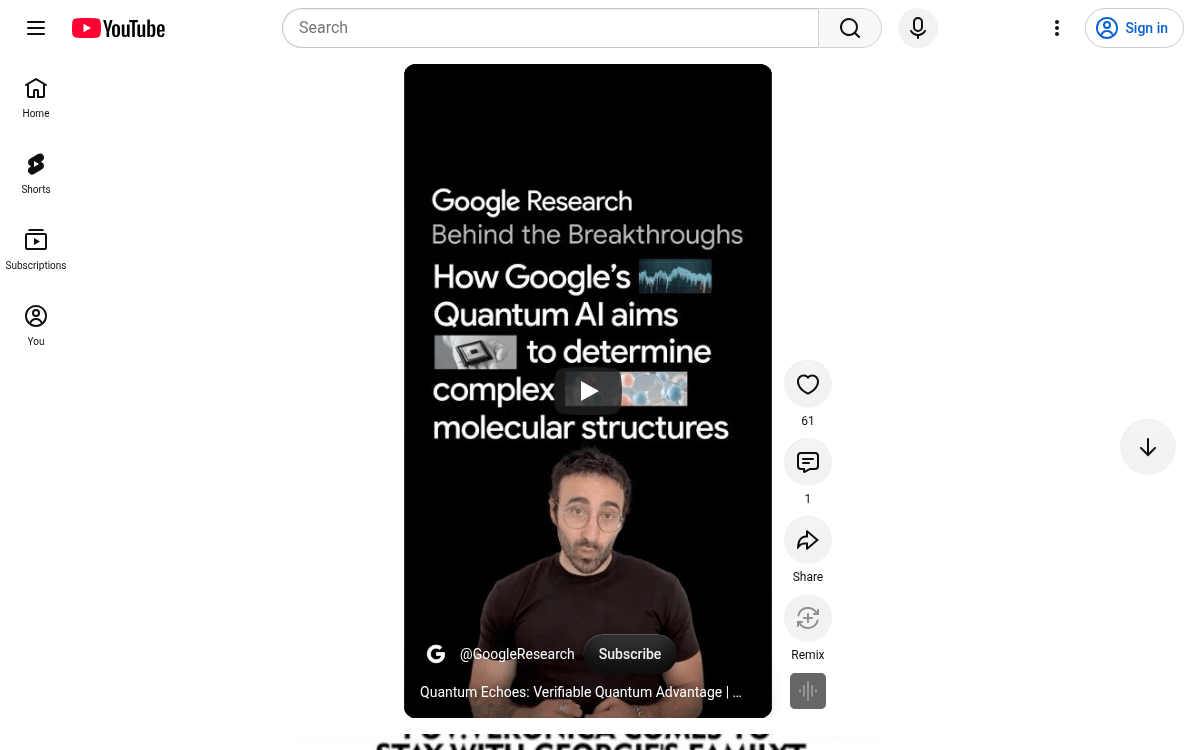
- Google's Quantum Echoes algorithm on the Willow chip achieves the first-ever verifiable quantum advantage, published in Nature.
- Willow runs the algorithm 13,000x faster than the world's fastest classical supercomputers on this task.
- The result is "quantum verifiable" -- reproducible on any other quantum computer of equivalent quality, not just a one-off benchmark.
- In collaboration with UC Berkeley, the team used Quantum Echoes as a "molecular ruler" to analyze molecules of 15 and 28 atoms using NMR data.
- Key applications include drug discovery (how medicines bind to targets) and materials science (polymers, battery components, qubit materials).
- Google's next milestone is a long-lived logical qubit; the field must now reckon with useful quantum algorithms running on today's noisy, pre-fault-tolerant hardware.
For years, quantum computing's big claims came with a catch: the problems solved were either artificial, unverifiable, or both. Google just changed that. The Quantum Echoes algorithm, running on the Willow chip, has achieved the first-ever verifiable quantum advantage on real hardware, and it's already being applied to decode molecular structures that would stump the world's fastest supercomputers for centuries.
The problem with past "quantum supremacy"
Unlike Google's controversial 2019 "quantum supremacy" claim, which used artificial problems designed specifically for quantum hardware, this achievement tackles genuine scientific challenges with practical applications. That 2019 result was essentially a benchmark with no real-world use. The criticism was fair: quantum computers were solving problems nobody actually needed solved.
Quantum Echoes is different. The experiment is described as "quantum verifiable," meaning the result is repeatable and can be cross-benchmarked by other quantum computers of similar quality. That's a crucial distinction. A result you can't verify independently is just a claim. A result you can reproduce on any sufficiently capable quantum machine is science.
What Quantum Echoes actually does
The algorithm is built around a concept called an Out-of-Time-Order Correlator (OTOC), which measures how quickly information spreads and scrambles across a quantum system. Think of it as a way to probe the hidden internal dynamics of a physical system by watching how a disturbance ripples through it.
The Quantum Echoes algorithm uses a time-reversal protocol to send a signal into a quantum system, perturb one qubit, and then precisely reverse the signal's evolution to listen for an "echo" amplified by constructive interference. This technique enables access to complex correlations that are otherwise scrambled by the system's dynamics. The echo is the signal. The stronger the echo, the more information you extract.
The four-step process on Willow's 105-qubit array looks like this:
- Run quantum operations forward through the system
- Perturb a single qubit
- Run operations backward (time-reversal)
- Measure the resulting echo signal
The experiment, published in Nature, ran on the Willow superconducting quantum processor and achieved a speed advantage of 13,000x over the fastest classical supercomputers for this task. For reference, work that would take the Frontier supercomputer approximately 150 years to complete, Willow accomplished in a practical timeframe.
The hardware that made it possible
This result didn't happen by accident. It required pushing Willow's hardware to its limits. The current-generation Willow chip, benefiting from continuous post-release improvements, delivers best-in-class performance at scale. Across its entire 105-qubit array, it features fidelities of 99.97% for single-qubit gates, 99.88% for entangling gates, and 99.5% for readout.
Speed matters as much as accuracy here. The Willow system can perform millions of Quantum Echoes measurements in just tens of seconds. Over the course of the project, the team accumulated one trillion total measurements, which Google describes as a significant fraction of all measurements ever performed on all quantum computers combined. That's not a footnote, it's a statement about the scale of experimental rigor behind this result.
Another key takeaway is the importance of co-designing hardware and algorithms. Achieving the Quantum Echoes experiment required extremely low error rates, high-speed operations, and software precisely tailored to the Willow chip's unique architecture.
From physics benchmark to molecular ruler
The physics result alone would be notable. But Google went further. In a separate proof-of-principle experiment with the University of California, Berkeley, Google applied the Quantum Echoes algorithm to study two organic molecules using Nuclear Magnetic Resonance (NMR) data. This application, which they call a "molecular ruler," demonstrated the potential to measure longer distances than today's methods, revealing information about chemical structure.
The groups ran the Quantum Echoes algorithm on Willow to study two molecules, one with 15 atoms and another with 28 atoms. "The results on our quantum computer matched those of traditional NMR, and revealed information not usually available from NMR, which is a crucial validation of our approach," Neven and Smelyanskiy wrote.
NMR (Nuclear Magnetic Resonance) is the same underlying science as MRI. It's already one of chemistry's most powerful tools for understanding molecular structure. The quantum-enhanced version doesn't replace it, it extends it, measuring atomic distances that conventional NMR simply can't reach.
Where this actually matters
The practical implications are concentrated in a few high-value areas:
- Drug discovery: Quantum computing-enhanced NMR could become a powerful tool in drug discovery, helping determine how potential medicines bind to their targets.
- Materials science: QC-enhanced NMR could become a powerful tool in characterizing the molecular structure of new materials, such as polymers, battery components, or even other quantum bits.
- Fundamental physics: The OTOC measurement itself is relevant to understanding information scrambling in quantum systems, with connections to black hole physics and quantum chaos theory.
In collaboration with researchers at the University of California, Berkeley, the team used the method as a "molecular ruler," measuring atomic distances more precisely than conventional nuclear magnetic resonance (NMR) techniques. This suggests that quantum computation is beginning to make measurable contributions to chemistry and materials science, two of the most promising fields for early quantum applications.
What this doesn't mean (yet)
It's worth being precise about the scope of this win. It's still a far cry from general-purpose quantum computing, but it expands the frontier of tasks quantum computers can do that classical ones effectively cannot. Quantum advantage in this context does not mean quantum computers are now universally superior for most tasks.
The hardware limitations are real. Even with Willow's impressive 99.97% fidelity rates, errors accumulate in longer computations. Quantum error correction is essential for scaling to larger problems, but it requires significant overhead, potentially needing hundreds or thousands of physical qubits to create a single error-corrected logical qubit.
Google's claims are credible given the evidence, but we'll need to see if any classical breakthroughs or independent validations occur. As of now, the scientific paper has passed peer review at Nature, indicating that at least a group of experts found the results convincing.
What the field needs to update
The standard assumption has been that quantum advantage requires fault-tolerant, error-corrected machines with millions of qubits. Quantum Echoes challenges that. A 105-qubit chip with very high fidelity, running a cleverly designed algorithm, can already produce results that no classical machine can match, and that can be independently verified.
This reframes the near-term quantum roadmap. The question is no longer just "when will we have a fault-tolerant machine?" but also "what useful algorithms can we run on today's noisy hardware?" The two tracks are now running in parallel.
"As we scale up towards a full-scale, error-corrected quantum computer, we expect many more such useful real-world applications to be invented. Now, we're focused on achieving Milestone 3 on our quantum hardware roadmap, a long-lived logical qubit." That next milestone, a long-lived logical qubit, is the bridge between today's noisy hardware and tomorrow's fault-tolerant machines. Google's hardware roadmap now has a verified real-world result anchoring its progress, not just a benchmark.
Comments
