



Google just pulled off something that almost never happens in AI: it got its direct competitors to adopt its own technology. At Google I/O 2026, the company announced a sweeping expansion of SynthID, its invisible watermarking system for AI-generated content, bringing it into Google Search and Chrome, and signing OpenAI, ElevenLabs, and Kakao as new adopters. The move signals a shift from internal safety tooling to something closer to an industry-wide standard.
What SynthID actually does
SynthID works by embedding an imperceptible signal directly into the pixels of an image, the waveform of audio, or the token probability distribution of generated text at the moment of creation. Unlike metadata-based approaches, which can be stripped by simply re-saving a file, SynthID is designed to survive compression, cropping, rotation, and other common transformations. A detector then scans the content and reports whether the signal is present, absent, or uncertain.
The scale at which this is already deployed is striking. SynthID has already been applied to over 100 billion images and videos, and the equivalent of 60,000 years of content has been watermarked for audio. For context, that audio figure alone dwarfs any comparable system currently operating at scale.
From Gemini to everywhere you actually browse
Until now, SynthID verification lived mostly inside the Gemini app. That's changing fast. Until recently, checking whether something was AI-generated meant opening the Gemini app and uploading the file yourself. That verification step happened 50 million times globally. Useful, but not where most people actually look at images. Search is.
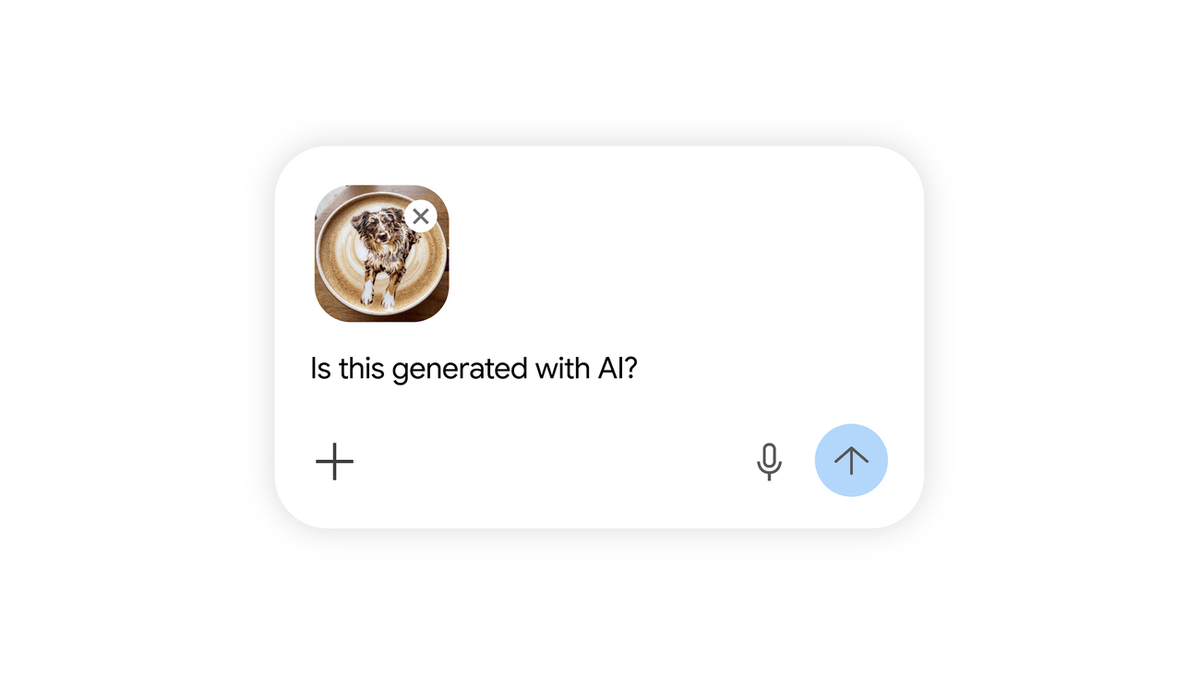
Google is expanding its SynthID verification tools to Search, with Chrome support planned over the coming weeks. Users will be able to check the origin of images through Search features such as Lens, AI Mode, and Circle to Search. The interface is intentionally simple: you can check whether an image was made with AI through features like Lens, AI Mode, and Circle to Search, by asking questions like "Is this made with AI?" or "Is this AI generated?"
Google is also layering in support for C2PA Content Credentials (the Coalition for Content Provenance and Authenticity standard, which embeds a cryptographically signed record of how a file was created and modified). Google is adding verification for C2PA Content Credentials, an industry standard for recording how media was created and modified. The C2PA verification feature is rolling out in the Gemini app and will roll out to Search and Chrome in the coming months.


Don't miss what's next in AI
Join 300,000+ engineers and researchers who get the signal, not the noise.
- Full access to in-depth AI research breakdowns
- Be the first to know what's trending before it hits mainstream
- Daily curated papers, repos, and industry moves