

Google's SensorFM Beats 34 of 35 Health Tasks Trained on a Trillion Minutes
Google's SensorFM is trained on 1 trillion minutes of Fitbit and Pixel Watch data from 5 million people, transferring across 35 health prediction tasks with no task-specific architecture

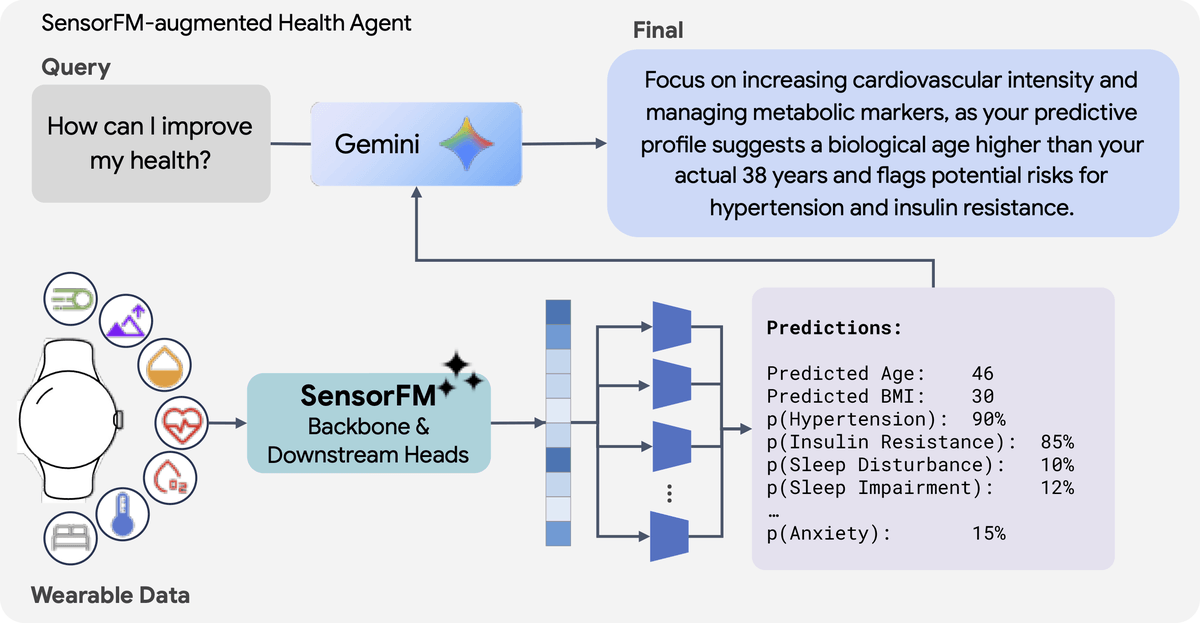
- Scale record: SensorFM is pre-trained on 1 trillion minutes of wearable data from 5 million consented Fitbit and Pixel Watch users -- the largest wearable dataset used to train a model to date.
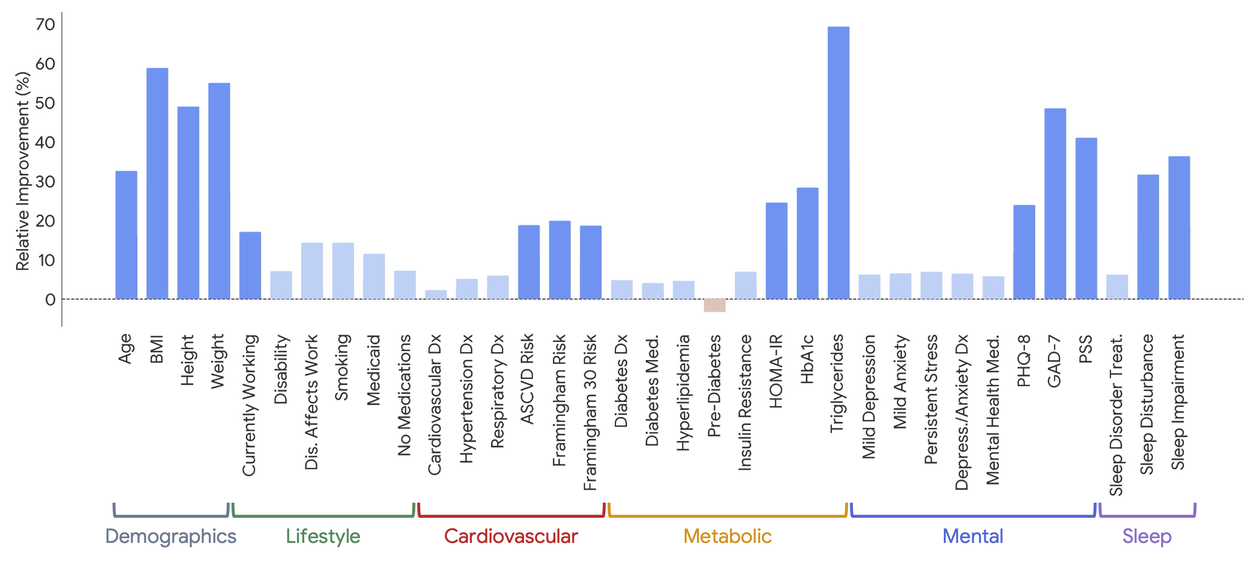
- Broad generalization: A frozen SensorFM encoder with a simple linear head outperforms supervised, hand-engineered baselines on 34 of 35 health prediction tasks across cardiovascular, metabolic, sleep, and mental health domains.
- Key innovation: Adaptive and Inherited Masking (AIM) trains directly on incomplete, fragmented wearable data rather than discarding or imputing gaps -- making the model robust to real-world sensor dropout.
- Agentic code generation: An LLM "classroom" of collaborating agents explored 30,000+ candidate prediction heads automatically, beating manual linear probes on the majority of tasks.
- Health agent grounding: Clinicians rated SensorFM-grounded health summaries as equivalent to summaries grounded in actual ground-truth measurements across all five evaluation rubrics.
- Availability: Research paper is available on arXiv; no public weights or API have been announced.
Most health AI models are built one condition at a time: a separate model for sleep, another for heart risk, another for depression. Each needs its own labeled dataset, its own architecture, and its own training run. SensorFM, a new foundation model from Google Research, bets that a single, massive pre-training run on raw wearable data can replace all of that -- and the results are hard to argue with.
SensorFM is a foundation model for wearable health pre-trained on more than one trillion minutes of sensor data from five million people. By co-scaling model size and data, it learns a general-purpose representation of human physiology that transfers to 35 health prediction tasks, supports label-efficient adaptation and data infilling, and can serve as a grounding tool for a Personal Health Agent. To Google's knowledge, this is the largest and most diverse wearable dataset used to train a model to date.
The problem with wearable health AI today
While ubiquitous wearable sensors capture a wealth of behavioral and physiological information, converting low-level sensor data into representations capable of characterizing higher-level health states is difficult due to high phenotypic diversity and variation in individual baseline health, physiology, and lifestyle factors. Moreover, collecting wearable data paired with health outcome annotations is laborious and expensive, and retrospective annotation remains practically unfeasible, contributing to a scarcity of data with high-quality labels.
This is the core bottleneck. You can collect billions of hours of heart rate and step data passively, but the moment you need a label -- a confirmed depression diagnosis, a blood glucose reading, a validated sleep study -- you need clinicians, IRB approvals, and years of prospective data collection. SensorFM sidesteps this entirely by learning from the raw signals alone.
A trillion minutes of unlabeled physiology
The pre-training corpus was built from de-identified data from five million people who had consented to the use of their data for health and wellness research, captured between September 2024 and September 2025. The dataset spans more than 100 countries, all 50 U.S. states, and over 20 Fitbit and Pixel Watch device models.

SensorFM ingests 34 one-minute aggregate features derived from five sensor types:
- PPG (photoplethysmography) -- heart rate, heart rate variability, blood-oxygen saturation
- Accelerometry -- motion, steps, sleep stages
- Electrodermal activity (EDA) -- skin conductance, a proxy for stress arousal
- Skin temperature -- continuous thermal readings
- Altimetry -- elevation changes over a full 24-hour window
The key innovation: learning from broken data
The training method is where things get interesting. Standard self-supervised approaches (like masked autoencoders) assume your input is mostly complete -- you hide some tokens, and the model learns to reconstruct them. But wearable data is almost never complete. Sensors power-cycle, devices come off the wrist, battery-saving modes kick in.
SensorFM builds on an approach called Adaptive and Inherited Masking (AIM). Rather than imputing gaps or discarding incomplete windows, AIM treats real-world missingness as a natural artifact. It combines tokens inherited from genuine gaps with tokens artificially masked for the reconstruction objective, treating both as equivalent. The result is a model that is missingness-aware by construction -- it doesn't just tolerate fragmented data, it actively learns from it.
Scale translates directly into capability
Google ran scaling experiments across four orders of magnitude in both data volume (roughly 2 million to 2 billion sensor-hours) and model size (100K to 100M parameters). The findings are clean:
- The largest model (SensorFM-B) trained on the full five-million-person corpus reduces reconstruction loss by 31% over the smallest variant, and improves downstream performance by an average 9% gain (AUC) on classification tasks and 21% gain (Pearson Coefficient) on regression tasks.
- Increasing data and capacity in proportion produces near-linear gains in both generative pre-training and discriminative downstream performance.
- The scaling curve shows no sign of saturating -- bigger is still better.
- SensorFM-B wins on 33 of 35 downstream tasks.

One frozen encoder, 35 health tasks
To test generalization, the team kept the SensorFM encoder completely frozen and trained only a lightweight linear head on top -- the simplest possible adaptation. They then compared against supervised baselines trained on hand-engineered features across 35 tasks drawn from three independent IRB-approved prospective studies with 13,985 participants.
The results across six health categories:
- Cardiovascular health -- atrial fibrillation risk, heart rate variability patterns
- Metabolic risk -- insulin resistance proxies, activity-linked metabolic signals
- Mental health -- depression and anxiety indicators
- Sleep -- staging, quality, and disorder risk
- Demographics -- age, sex inferred from physiology
- Lifestyle -- activity levels, sedentary behavior
Linear probes on SensorFM embeddings outperform the feature-engineered supervised baseline on 34 of 35 tasks, without any task-specific architecture. Scaled pre-training is especially valuable for conditions like depression and anxiety, which vary from person to person and leave only faint traces in sensor data. The model appears to learn the individual differences that usually bury such signals.
One particularly notable finding: adding demographic features (age, sex) gives a modest boost to downstream performance -- but that boost shrinks as the model scales. Larger models appear to implicitly capture physiologically relevant traits during pre-training, reducing the need to hand-feed them in.
An agentic "classroom" to build prediction heads automatically
Adapting a general embedding to a specific health endpoint still requires building a prediction head -- choosing an architecture, tuning hyperparameters, selecting features. Google automated this with an agentic system: a set of collaborating and competing LLM agents that iteratively generate, test, and refine executable code to build prediction heads on the SensorFM embeddings.
Across experiments, the system explored more than 30,000 candidate solutions. The agent-designed heads beat a simple linear probe on 16 of 20 classification tasks and 12 of 15 regression tasks. Two patterns stood out: solution quality improves monotonically over the search, and it scales with the capability of the underlying LLM -- more capable models produce better solutions, while collaboration between agents helps less capable models close the gap.
Grounding a Personal Health Agent
The most striking application is using SensorFM as the physiological backbone for a conversational health AI. Google integrated it into a Personal Health Agent and ran a blinded clinical evaluation: a panel of clinicians rated health summaries generated under three conditions -- using SensorFM predictions, using actual ground-truth measurements, or using only raw daily metrics.
The evaluation covered 31 real participant profiles, producing 1,860 clinician ratings across five rubric dimensions: context, relevance, justifiability, personalization, and potential for harm. Adding SensorFM predictions significantly improved responses over the baseline on every rubric dimension. And there was no statistically significant difference between grounding the agent in SensorFM predictions versus actual ground-truth measurements -- meaning the model's inferences served the agent about as well as the real labels would have.
The industry context: a crowded race for the health data layer
The wearable industry's center of gravity is shifting from activity tracking toward continuous health monitoring covering cardiovascular risk, metabolic health, mental wellbeing, and respiratory function. The wearable fitness tracker market is projected at $70.3 billion in 2026, up from $60.0 billion in 2025. Every major platform wants to own the intelligence layer on top of that data.
Google currently trails Apple, Samsung, Xiaomi, and Huawei in global wearable market share. According to IDC, Apple still captures roughly 60 percent of all smartwatch revenue. SensorFM is part of a broader strategy: rather than fighting for unit sales alone, Google is opening its ecosystem, with Rishi Chandra, VP and General Manager for Google Health, confirming that the ultimate goal is for the AI coach to work with data imported from Apple's HealthKit and Android's Health Connect.
Apple is not standing still either. While foundation models are increasingly used for wearable health predictions, Apple has been applying them to behavioral data using over 2.5 billion hours of wearable data from 162,000 individuals, evaluated on 57 health-related tasks. The gap in dataset scale -- 5 million people vs. 162,000 -- is notable, though Apple's approach focuses on behavioral signals rather than raw sensor reconstruction.
What this means for the field
SensorFM challenges a foundational assumption in wearable health research: that you need labeled data and task-specific models to build useful health predictions. The paper demonstrates that a single pre-trained encoder, frozen and probed with a linear head, beats hand-engineered supervised models on nearly every task tested. That's a significant result.
The practical implications are real. If the SensorFM embeddings (or a similar model) were made available via API, a researcher studying a new health endpoint would need only:
- A small labeled dataset of their target condition
- A lightweight prediction head (which the agentic classroom can generate automatically)
- Access to Fitbit or Pixel Watch data from consented participants
The model is currently a research release with a paper on arXiv. There is no public API or open weights announced at this time -- it remains an internal Google Research system. But the direction is clear: Google is building the infrastructure to make its wearable data advantage into a platform, and SensorFM is the foundation layer of that bet.
Comments
