


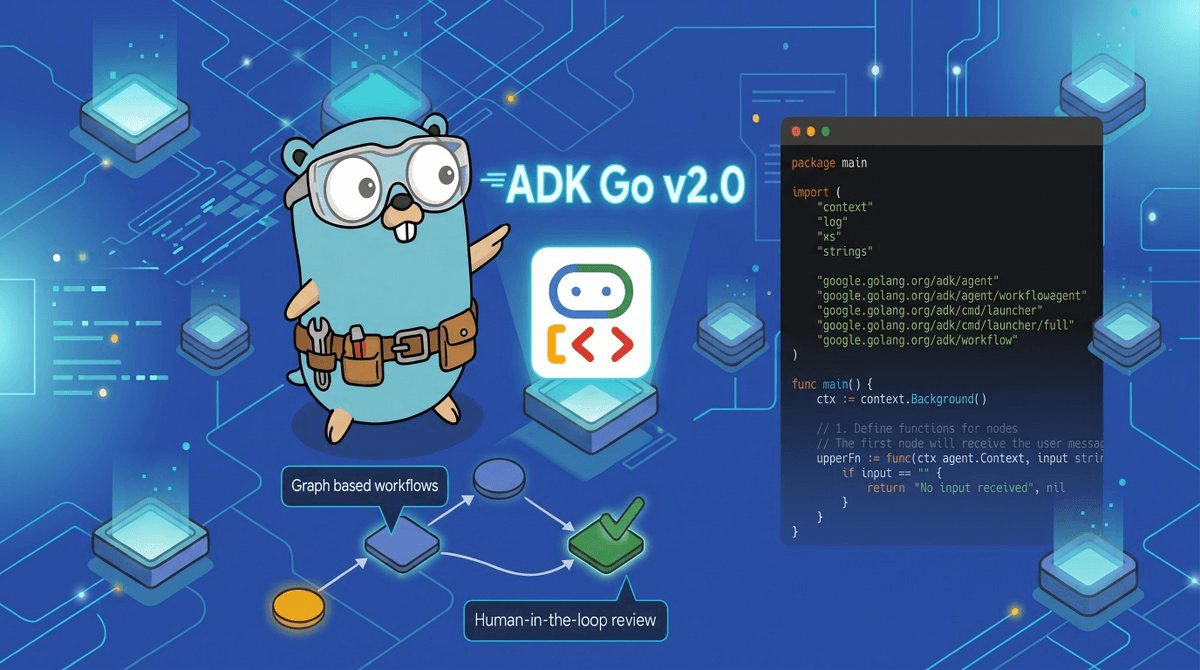
Google just shipped ADK Go 2.0, a major overhaul of its Agent Development Kit for Go. The headline feature is a brand-new graph-based workflow engine that lets you compose agents, tools, and plain Go functions as nodes in a directed graph , with a concurrent scheduler handling execution, retries, state persistence, and human approval checkpoints. The repo already sits at 8.3k stars, and this release brings Go to feature parity with the Python ADK 2.0 that went GA in May.
The problem with ad-hoc agent orchestration
Most real agent applications are not a single prompt-and-response. They classify inputs, branch to specialist agents, fan out work in parallel, gather results, and sometimes need a human to sign off before proceeding. Expressing that complex orchestration as ad-hoc control flow gets brittle fast. The typical fix , long system prompts with embedded instructions , trades reliability for flexibility, and debugging becomes a guessing game.
The ADK 2.0 release introduces the Workflow Runtime, transitioning ADK from a hierarchical agent executor to a graph-based execution engine where Agents, Tools, and Functions are evaluated as individual nodes within a workflow graph. The mental model shift is significant: instead of writing imperative orchestration code that calls agents in sequence, you declare the shape of your application as a graph and hand execution to a scheduler.
A graph is just an agent
The cleanest design decision in 2.0 is that a workflow graph is itself an agent.Agent. It runs in the same runner, launcher, and console you already use , no special harness, no new server. Here is the minimal wiring to chain two function nodes together:
import "google.golang.org/adk/v2/workflow"
upper  := workflow.NewFunctionNode("upper",  upperFn,  cfg)
suffix := workflow.NewFunctionNode("suffix", suffixFn, cfg)
edges := workflow.Chain(workflow.Start, upper, suffix)
wf, _ := workflowagent.New(workflowagent.Config{
    Name:  "simple_sequence_workflow",
    Edges: edges,
})
Generics infer the input/output schemas from the function signatures, so you get typed data flowing through the graph without manual wiring. Single agents and full graphs now run on the same execution model.


Don't miss what's next in AI
Join 300,000+ engineers and researchers who get the signal, not the noise.
- Full access to in-depth AI research breakdowns
- Be the first to know what's trending before it hits mainstream
- Daily curated papers, repos, and industry moves