



Open source maintainers have been quietly drowning. The number of pull requests merged on GitHub has gone from roughly 25 million per month in early 2023 to over 90 million today , a 3.6x surge driven in large part by AI-assisted code generation. The cost to open a PR has collapsed. The cost to review one hasn't moved. GitHub is now shipping tooling to address that asymmetry head-on.
Pull request limits are a new repository-level setting that lets maintainers cap how many open PRs a contributor without write access can hold at any given time. Hit the cap, and you have to close or merge an existing PR before opening a new one. It's a simple constraint with a surprisingly strong behavioral effect.
How it actually works
Maintainers of open source repositories are dealing with an ever-growing volume of pull requests, including repeated low-quality or drive-by contributions that can slow triage and overwhelm review queues. The new setting lets you define a maximum number of open PRs that users without write access may have open in your repository at one time. The limit applies to all external contributors by default, including AI agents , pull requests opened by Copilot or another AI agent count toward the limit.
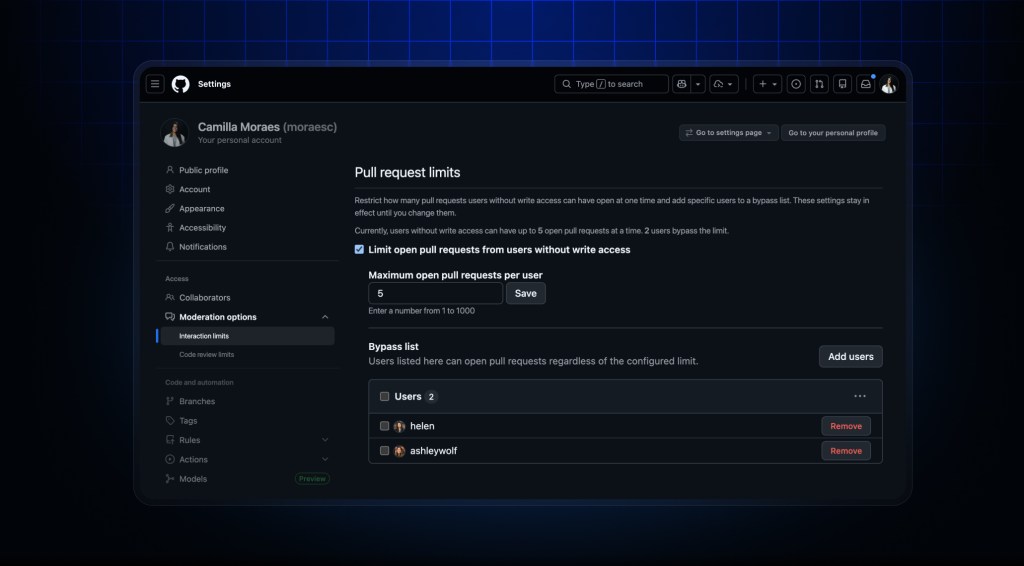
A few important nuances in the mechanics:
- If a user without write access reaches the limit, they'll need to close or merge an existing pull request before opening another one.


Don't miss what's next in AI
Join 300,000+ engineers and researchers who get the signal, not the noise.
- Full access to in-depth AI research breakdowns
- Be the first to know what's trending before it hits mainstream
- Daily curated papers, repos, and industry moves