



Kimi K3 is now available as a selectable model inside Devin Desktop and Devin CLI. That alone would be a minor integration note -- but the reason Cognition is excited about it is more interesting: K3 is the first open-source model they have tested that approaches the performance of closed frontier models on real-world engineering tasks. For teams that want frontier-grade agentic coding without locking into proprietary APIs, this is a meaningful shift.
A benchmark built for production, not for headlines
Cognition evaluates models on FrontierCode 1.1, their internal benchmark for real-world software engineering. Unlike academic benchmarks, FrontierCode grades solutions on two things that actually matter in production: whether the code is mergeable, and whether it meets quality standards. Solutions that fail blocking criteria score zero.
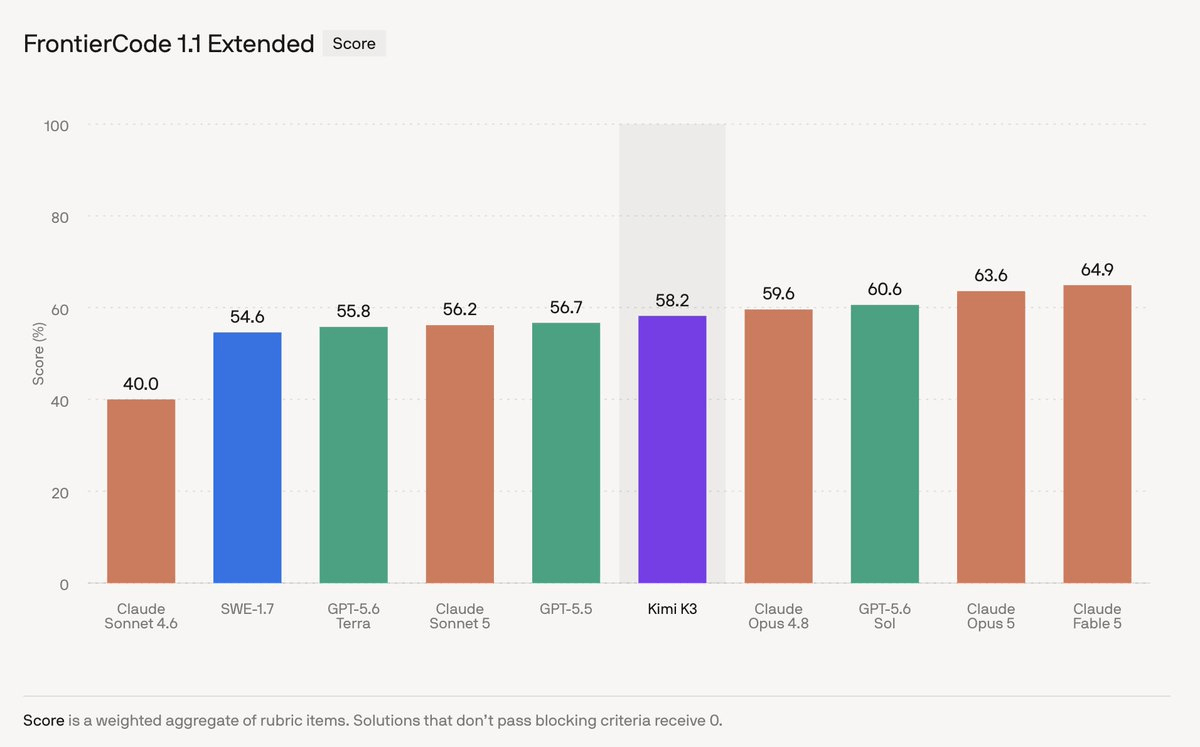
On FrontierCode 1.1 Extended, Kimi K3 scores 58.2% with a 63.6% pass rate. To put that in context:
- Claude Fable 5 leads at 64.9%
- Claude Opus 5 sits at 63.6%
- GPT-5.6 Sol scores 60.6%
- Kimi K3 at 58.2% -- the only open-source model in this tier
- GPT-5.5 at 56.7%
- Claude Sonnet 5 at 56.2%
Kimi K3 surpasses GPT-5.5 and falls only behind Opus, Fable, and GPT-5.6 Sol -- and it is the only open-source model that achieves this level of performance. That gap between K3 and the next-best open-source model is not incremental. It is categorical.
What it actually does well inside Devin
In Cognition's testing, Kimi K3 specifically excels at debugging. It discovers ground truth by running code, rather than assuming or pattern matching. It often opts to reproduce bugs on its own before editing any files. This is a meaningful behavioral difference from models that jump straight to edits based on static analysis.


Don't miss what's next in AI
Join 300,000+ engineers and researchers who get the signal, not the noise.
- Full access to in-depth AI research breakdowns
- Be the first to know what's trending before it hits mainstream
- Daily curated papers, repos, and industry moves