Cognition Raises $1B as Devin Writes 89% of Its Own Code
Cognition closes a $1B Series D at a $26B valuation as Devin writes 89% of its own code and revenue rockets from $37M to $492M in 12 months
- $1B Series D at $26B valuation — more than double Cognition's $10.2B valuation from just eight months ago, led by Lux Capital, General Catalyst, and 8VC.
- Revenue grew 1,230% in 12 months — from $37M to $492M annualized run-rate, with enterprise usage up 10x and 50% month-over-month growth for six consecutive months.
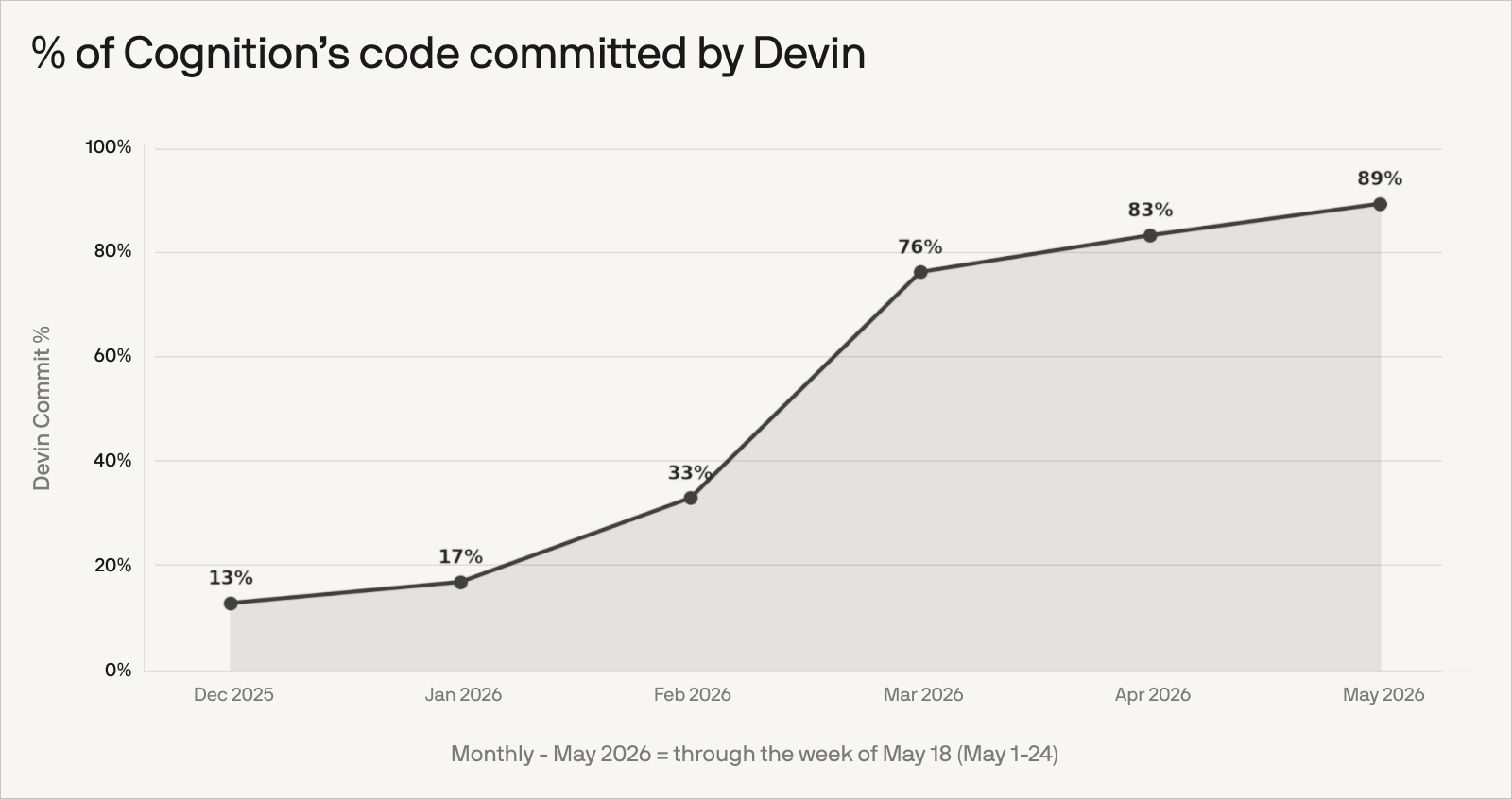
- Devin writes 89% of Cognition's own code — up from 13% in December 2025, the strongest real-world signal yet that autonomous coding agents work in production.
- Mercedes-Benz cut an 8-month project to 8 days using Devin; Itaú auto-resolves 70% of security vulnerabilities; Goldman Sachs, the U.S. Army, and the U.S. Navy are customers.
- Windsurf rebranded as Devin Desktop — Cognition acquired Windsurf's assets for ~$250M after Google poached its founding team, adding 350+ enterprise customers and the SWE-1.6 model running at 950 tok/s.
- Independence is the strategy — Cognition routes tasks across OpenAI, Anthropic, and its own SWE-1.6 model, positioning as an orchestration layer rather than betting on a single foundation model.
Cognition, the company behind the autonomous AI software engineer Devin, just closed over $1 billion in Series D funding at a $26 billion post-money valuation. That number alone would be headline-worthy, but the story underneath it is what makes this round remarkable: in 12 months, Cognition grew its annualized revenue run-rate from $37 million to $492 million, a 1,230% increase, while its own engineering team handed 89% of their code commits over to the very product they are building.
This is not a bet on future potential. It is a bet on a company that has already found product-market fit at rocket-ship scale.
The numbers behind the valuation
The $26B post-money figure is a major leap from Cognition's $10.2 billion post-money valuation when it closed a $400 million round just eight months ago in September. The company has now raised more than $2.5 billion in total funding. At this valuation, Cognition is priced at roughly 53 times revenue , aggressive by any standard, but hard to argue with when enterprise usage has grown more than 10x in a single year.
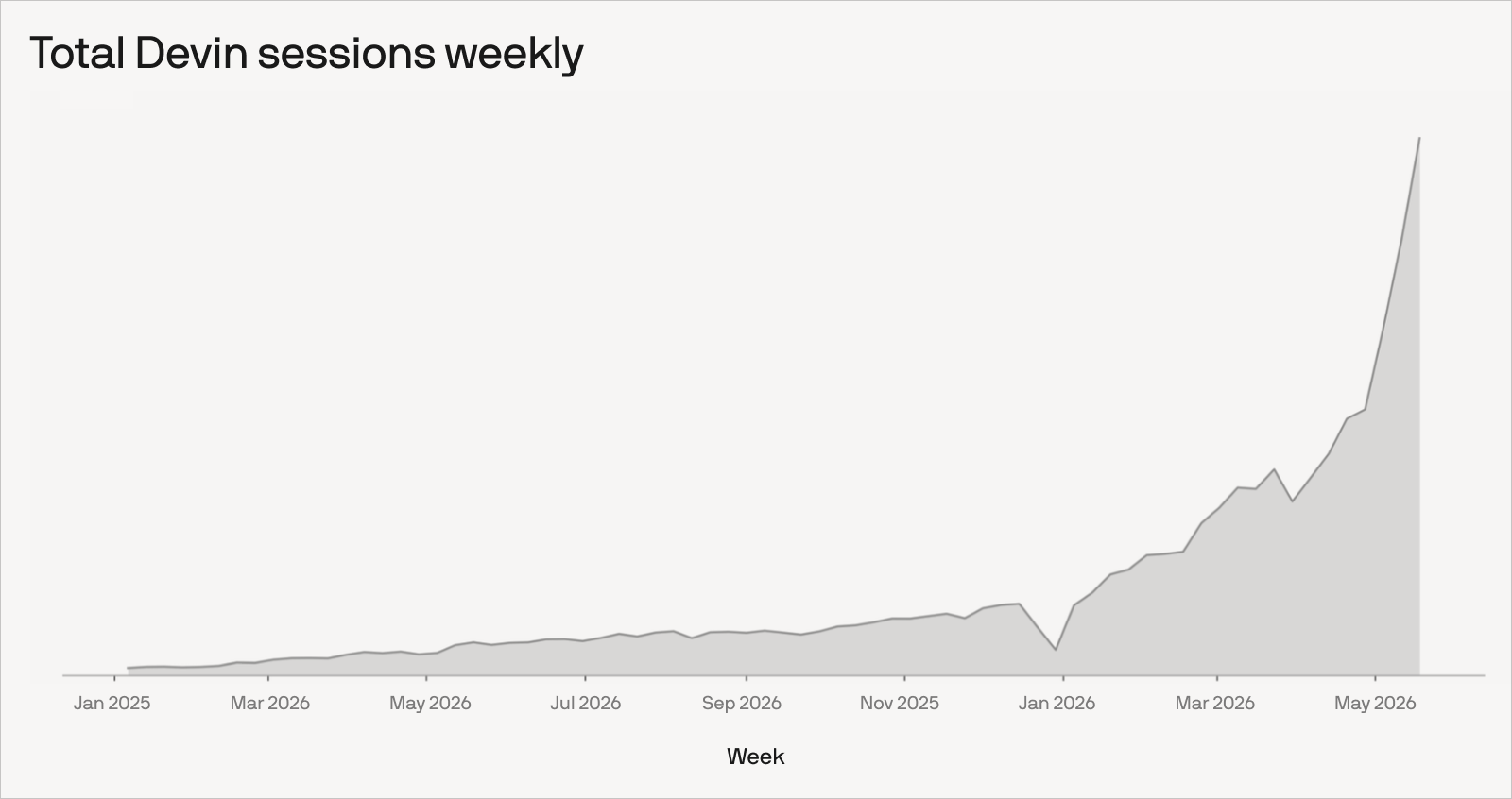
Enterprise usage of Devin has grown 50% month-over-month for the past six months. The company says it aims to cross $1 billion in annualized revenue later this year. For context, AI-native enterprise spending surged 94% year on year in early 2026 while traditional SaaS growth cooled to 8%.
Who is behind the round
The round was led by Lux Capital, General Catalyst, and 8VC, with support from existing investors including Founders Fund, Elad Gil, Alpha Wave, Definition Capital, Positive Sum, Avenir, Vitruvian, Bain Capital Ventures, Conversion Capital, 137 Ventures, Soma Capital, and Omri Casspi. New investors include Ribbit Capital, Atreides, and Layer Global.
Cognition was founded in November 2023 by Scott Wu (CEO), Steven Hao (CTO), and Walden Yan (CPO). Wu told Bloomberg the raise "allows us to stay independent and continue as an independent business, which is really important for us." That comment about independence is pointed, and intentional.
What Devin actually does
Cognition's flagship product is Devin, an AI agent designed to automate the programming process end-to-end. Unlike code completion tools that suggest lines or blocks of code while a human developer writes, Devin operates as a full coding agent that can take a task description and produce working software autonomously. It plans, writes, debugs, and deploys code across complex multi-step workflows. Think of it as assigning a ticket to a teammate who never needs to ask for clarification on the basics.
The clearest proof point is internal. Devin now writes 89% of Cognition's own committed code, up from 13% in December 2025 , a jump that happened in under six months. The chart below tells that story visually.
Enterprise customers are seeing similar results. Mercedes-Benz needed eight months to modernize a legacy system. Devin did it in eight days. Latin America's largest bank, Itaú, resolves 70% of security vulnerabilities automatically using Devin.
The Windsurf backstory
Cognition's current position was shaped by one of the messiest M&A episodes in recent AI history. OpenAI had agreed to acquire Windsurf for roughly $3 billion, but Microsoft demanded IP rights and the deal collapsed. Google then struck a $2.4 billion licensing and acquihire deal, taking CEO Varun Mohan, co-founder Douglas Chen, and about 40 key engineers. Just three days later, Cognition acquired the remaining IP, product, brand, and approximately 210 employees for an estimated $250 million.
At acquisition, Windsurf had $82 million in ARR, over 350 enterprise customers, and a 210-person team. Cognition's play was straightforward: they had Devin, a headless autonomous coding agent; Windsurf gave them a local IDE, a large existing developer user base, and a payment relationship with people already buying AI tools. Cognition has since consolidated its products under the Devin brand, turning Windsurf into Devin Desktop.
The model strategy: stay independent, stay model-agnostic
Cognition's positioning as an "independent agent lab" is a deliberate strategic choice, not just a marketing line. Cognition runs Devin on a mix of its own proprietary models and models from OpenAI and Anthropic. CEO Scott Wu framed this as a strategic advantage rather than a dependency. As the model layer gets more competitive, he said, working with a combination of models produces better results than relying on any single provider. Cognition routes customers to the best tools for their specific needs, positioning itself as an orchestration layer rather than a model company.
Part of that model strategy now includes in-house training. The SWE-1.6 model is technically the most interesting thing in the stack. Cognition trains it end-to-end via reinforcement learning on real task environments using a Cascade agent harness on top of an open-source base model. It runs at up to 950 tokens per second, making it one of the fastest models in any coding tool today.
The competitive battlefield
The AI coding market has never been more crowded or more consequential. The key distinction between Devin and most competitors comes down to autonomy:
- GitHub Copilot (Microsoft): Remains the largest deployed AI coding assistant by user count and continues to integrate deeply with the broader Microsoft developer ecosystem. It has quietly hit 4.7 million paid subscribers and 90% of Fortune 100 adoption.
- Cursor (Anysphere): Hit $2 billion in annual recurring revenue in roughly three years and was in talks to raise $2 billion at a $50 billion valuation before SpaceX struck a deal in April for the right to acquire the company for $60 billion.
- Claude Code (Anthropic): In the JetBrains April 2026 AI Pulse survey, 46% of developers named Claude Code as their most-loved coding tool, compared to 19% for Cursor and 9% for GitHub Copilot.
- Devin (Cognition): Both Copilot and Cursor assist human engineers in writing code; Devin takes ownership of the task itself and executes it autonomously.
The market for these tools reached $12.8 billion in 2026 and is growing at 27% CAGR, projecting toward $30.1 billion by 2032. The race is not just for developer mindshare , it is for the entire software development lifecycle.
Who wins, who loses, and what comes next
The customer roster is the credibility anchor: Goldman Sachs, Citi, Mercedes-Benz, Dell, and multiple U.S. government agencies have all deployed or piloted Devin , exactly the regulated, conservative buyers skeptics said would never trust an autonomous agent with production workloads. That list is a signal to the rest of the enterprise market that the risk calculus has shifted.
But it is not all upside. Hands-on reviewers consistently rate Devin around 3.8 out of 5 , excellent for well-scoped, repetitive tasks with mature CI/CD and clear acceptance criteria, but weak on novel architecture and ambiguous requirements. Veracode research across 100+ LLMs found AI-generated code carries roughly 2.74x more vulnerabilities than human-written code. The $26B valuation assumes this reliability gap closes fast. If it doesn't, "self-driving software" stays a supervised-driving product , valuable, but not the team-replacing engine the headline implies.
For individual engineers, the honest read is nuanced. CEO Scott Wu insists Devin operates at a junior-to-mid-level engineer and is meant to augment, not eliminate, developers , though the 89% internal code stat will fuel that debate for a long time. The company plans to use the new capital to maintain its independence and continue operating as an independent business as it scales its operations. Cognition also said it plans to use the funding to refine its models, improve the customer experience, and potentially make more acquisitions.
Some analysts draw parallels to the early days of cloud computing: a disruptive technology that starts as a productivity multiplier, then becomes table stakes, then rewrites entire business models. If coding agents follow a similar S-curve, $26B may look cheap in hindsight. The counter-argument is commoditization: if every major LLM provider offers a coding agent as a bundled feature, standalone companies like Cognition could face margin compression. The acquisition of Windsurf and the push toward model-agnostic orchestration suggest Cognition is already preparing for that scenario.
Comments