

Cerebras Doubles Revenue but Loses 10% as OpenAI Deal Masks Margin Collapse
Cerebras posts 92% revenue growth and a $20B OpenAI deal in its debut earnings report, but margin guidance sends the stock down 10%

- Revenue nearly doubled: Cerebras reported Q1 2026 GAAP revenue of $193.4M, up 94% YoY, beating analyst estimates of ~$181M.
- $20B OpenAI deal: A multi-year agreement for OpenAI to deploy 750MW of Cerebras inference compute, the largest contract in the company's history by far.
- Stock fell ~10% after-hours: Despite the revenue beat, Q2 gross margin guidance of 36-38% (down from 47% in Q1) spooked investors.
- AWS partnership unlocks hyperscaler distribution: A novel "disaggregated inference" architecture pairs AWS Trainium chips for prefill with Cerebras CS-3 for decode, with revenue expected in 2027.
- Largest semiconductor IPO ever: Cerebras raised $6.4B in its May 2026 Nasdaq debut, priced at $185/share, opening at $350.
- Margin squeeze is intentional: Cerebras is temporarily renting its own hardware back from G42 to bridge capacity gaps while building new data centers; management says data centers, not demand, are the bottleneck.
Cerebras Systems just handed Wall Street its first look under the hood as a public company, and the view is genuinely complicated. Revenue nearly doubled. Losses narrowed sharply. A $20 billion OpenAI contract landed on the books. And the stock still fell 10% in after-hours trading. That tension captures everything investors need to understand about where this company stands right now.
The Numbers That Matter
Cerebras reported Q1 2026 GAAP revenue of $193.4 million, up 94% year-over-year, with a GAAP gross margin of 45% and a GAAP operating loss of $15.0 million. On the non-GAAP "core" basis the company uses internally, the picture is even cleaner:
- Core revenue of $191.3 million, up 92% year-over-year, with hardware growing 60% and cloud services growing 167%
- Core gross margin of 47%, and core net loss of just $2.5 million
- Revenue surpassed analyst estimates of around $181 million
- Net loss narrowed to $14 million from $23.9 million in the prior year period
- The company ended Q1 with $3.3 billion in cash, equivalents, restricted cash, and short-term investments
The distinction between GAAP and "core" revenue matters here. Cerebras strips out pass-through data center costs and non-cash amortization of customer warrants (equity issued to customers like OpenAI that reduces reported revenue) to arrive at its core figures. It is a legitimate accounting choice, but investors should know the gap exists.
The Deal That Dwarfs Everything Else
The multi-year, 750 megawatt deployment agreement with OpenAI is valued at more than $20 billion , roughly 23 times the midpoint of the company's full-year 2026 core revenue guidance of $855 to $865 million. To put that in perspective: Cerebras just reported its best quarter ever, and the OpenAI contract alone is worth more than 23 years of that revenue run rate.
Under the deal, OpenAI will deploy 750 megawatts of Cerebras' high-speed inference compute over the next several years. The two companies also co-launched Codex-Spark, a model designed for near-instant coding and optimized for interactive work where latency matters, delivering more than 1,000 tokens per second. GPT-5.3-Codex-Spark marks OpenAI's first production deployment on silicon outside its long-standing core stack with Nvidia.
The arrangement goes far beyond a standard vendor-customer relationship. OpenAI and Cerebras are co-designing future models for future Cerebras hardware , a tight feedback loop that gives Cerebras visibility into frontier model architectures before they ship and gives OpenAI inference systems optimized for its specific workloads.
The financial structure of the relationship is also unusual. A $621 million current loan from a customer, plus a $362 million non-current portion on the balance sheet, is OpenAI essentially pre-funding the capacity Cerebras will build to serve it. OpenAI also holds a warrant to purchase up to 33.4 million shares of Cerebras Class N common stock at an exercise price of essentially zero, vesting as Cerebras delivers committed capacity. At the IPO opening price, the fully vested warrant would be worth approximately $11.7 billion.
The AWS Angle: Disaggregated Inference
In March 2026, Cerebras signed a binding term sheet with AWS to become the first hyperscaler to deploy Cerebras systems inside its own data centers. The partnership introduces a novel architectural concept called disaggregated inference, which splits the two stages of AI inference , prefill (processing the user's prompt) and decode (generating the response) , across different hardware optimized for each task. Under this arrangement, AWS Trainium chips handle prefill, while Cerebras CS-3 systems handle decode, connected via Amazon's Elastic Fabric Adapter networking.
This is a meaningful architectural bet. Rather than competing head-on with Nvidia's GPU clusters for every workload, Cerebras is positioning its hardware as the specialized decode engine in a hybrid stack. CEO Andrew Feldman said AWS should begin contributing revenue in 2027.
Why the Stock Fell Despite the Beat
Cerebras beat expectations in its first earnings report since its May IPO, but lowered growth and margin expectations for the coming quarters as it attempts to meet the demands of big partnerships with OpenAI and AWS. The specific number that spooked markets: Q2 core gross margin guidance of 36% to 38% represents a sharp compression from the 47% core gross margin posted in Q1.
The reason for that compression is actually a good problem to have. Cerebras is temporarily renting its own systems back from an existing customer while it aggressively builds out and deploys its own data center capacity. The additional cost of renting third-party capacity will depress cloud and services margins temporarily from current levels. In other words, demand is outpacing supply, and the company is paying a premium to bridge the gap.
CEO Andrew Feldman was direct on the earnings call: "Demand is not the constraint. Supply is not the constraint. The constraint is data centers." Management said capacity , not demand , is the main bottleneck, and expects new facilities to come online in the second half of 2026 and into 2027.
The company expects increasing year-over-year growth rates for each quarter in 2026, with more revenue coming later in the year as cloud capacity deployments accelerate. Full-year guidance calls for core revenue of $855 to $865 million, up 69% year-over-year at the midpoint. But the operating margin picture is sobering: core operating margin is guided to negative 28% to 32% for the year, which means losses widen in absolute terms even as revenue scales 69% at the midpoint.
The Architecture Behind the Hype
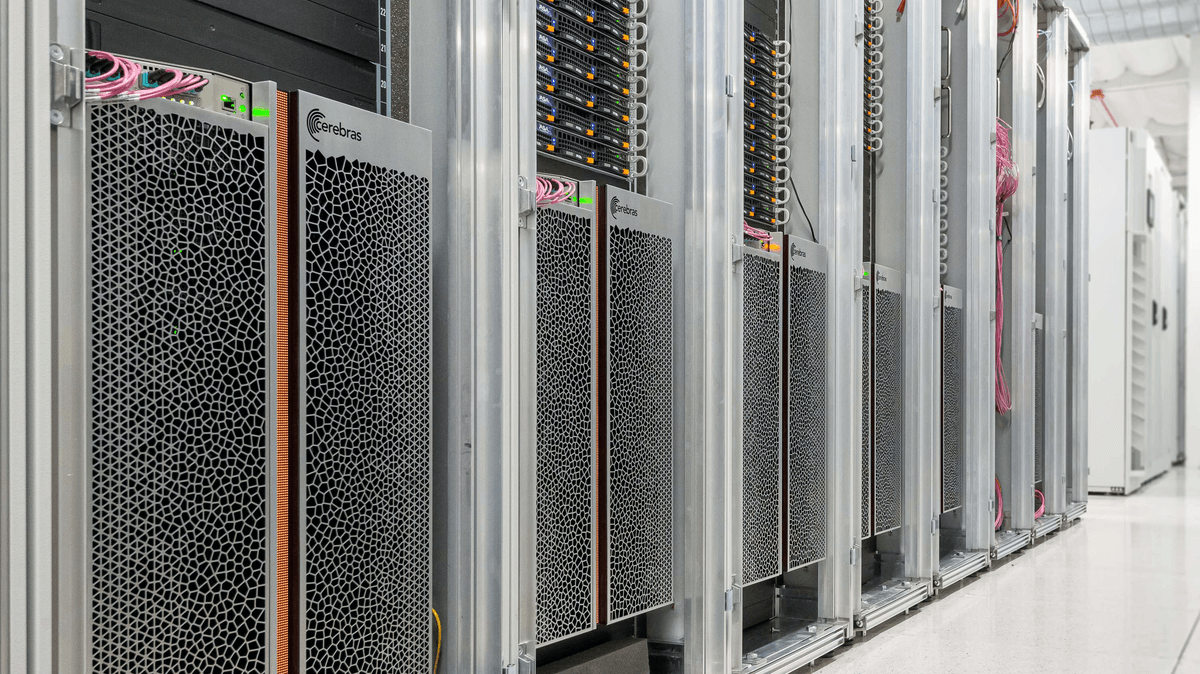
To understand why any of this matters, you need to understand what Cerebras actually builds. The company's core barrier lies in its proprietary Wafer Scale Engine (WSE) architecture , abandoning the traditional GPU practice of relying on multi-chip stitching to directly integrate an entire 12-inch wafer into a single processor. Its unique speed comes from putting massive compute, memory, and bandwidth together on a single giant chip and eliminating the bottlenecks that slow inference on conventional hardware.
The practical result: this design significantly reduces inter-chip communication latency, allowing Cerebras' processing efficiency in AI inference scenarios to reach 10 to 20 times that of Nvidia's GPU systems. The tradeoff is cost and manufacturing complexity. Cerebras semiconductors are much more powerful than those of competitors; however, they have disadvantages due to their large size, 25kW power draw, and cost of as much as $3 million per node.
The industry shift driving all of this is the move from training to inference. The industry's shift from training AI models to deploying them for real-time inference is creating a new bottleneck. Enterprises need faster, more efficient hardware to run AI agents, and Cerebras's wafer-scale architecture is being seen as a credible alternative to the incumbent.
The IPO That Started It All
Founded in 2015, Cerebras raised over $6 billion in its offering, the most for a U.S. technology company since Uber's debut in 2019. After pricing its IPO at $185, Cerebras saw its stock open at $350 and close at $311.07. The road to that debut was not smooth: its initial go at an IPO was derailed by worries about its reliance on investors and revenue sources associated with the United Arab Emirates. The two UAE-linked entities , G42 and MBZUAI , still represented 86% of Cerebras's 2025 sales, and MBZUAI accounted for 77.9% of accounts receivable as of December 31, 2025.
The OpenAI and AWS deals represent a deliberate pivot away from that concentration. But the risk has not disappeared , it has shifted. OpenAI, G42, MBZUAI, and AWS now dominate the revenue story. The Master Relationship Agreement with OpenAI is the most important commercial document this company has, and any wobble there would do real damage to the thesis.
Who Wins, Who Watches Nervously
The clearest winner in this story is the inference-as-a-service market. When AI responds in real time, users do more with it, stay longer, and run higher-value workloads , and Cerebras is the only public company with a pure-play bet on that thesis at scale. For developers building latency-sensitive applications , coding assistants, AI agents, real-time search , access to Cerebras inference through AWS Bedrock could eventually mean dramatically faster response times without having to procure hardware directly.
Nvidia is not losing sleep yet. The 750MW Cerebras capacity will not replace Nvidia's role in OpenAI's training infrastructure; it gives the company a dedicated tier optimized for responsiveness rather than training. Nvidia dominates the broader AI chip market with roughly 80% share and a deeply entrenched CUDA software ecosystem that creates significant switching costs. Cerebras is carving out a niche in inference speed, not challenging Nvidia's total dominance.
The more immediate competitive pressure falls on inference-focused rivals like Groq. Nvidia's $20 billion Groq acquisition reshapes the Vera Rubin platform , meaning the incumbent is now directly competing in the fast-inference segment Cerebras has staked its future on.
The J-Curve Ahead
The concern is that the market may have priced in the OpenAI headline without fully digesting the J-curve. This is a heavy capex, capacity-led business now, and the next four quarters are about building, not earning. The bull case is straightforward: Cerebras has the fastest inference hardware in the world by independent benchmarks, a $20 billion anchor customer, AWS distribution, and $10 billion-plus of capital to deploy. If management executes, the FY2027 and FY2028 revenue numbers could look genuinely transformative.
Heading into the print, analyst sentiment was broadly constructive. Wedbush held an Outperform rating with a $270 price target, while Craig-Hallum, Needham, Rosenblatt, and Mizuho each carried Buy-equivalent ratings. Analysts maintain a bullish outlook with price targets suggesting 20-35% upside potential from current levels.
The next scheduled financial disclosure is the Q2 2026 earnings release on September 2, which will offer the first full-quarter view of how the OpenAI and AWS partnerships are translating into recognized revenue and whether the anticipated gross margin compression proves transitory or structural. That is the number to watch. Not the headline revenue beat, not the OpenAI contract size , but whether margins start recovering as owned data center capacity comes online and replaces the expensive rentback arrangement. That is the real test of whether Cerebras can turn the world's fastest AI chip into a durable business.
Comments
