



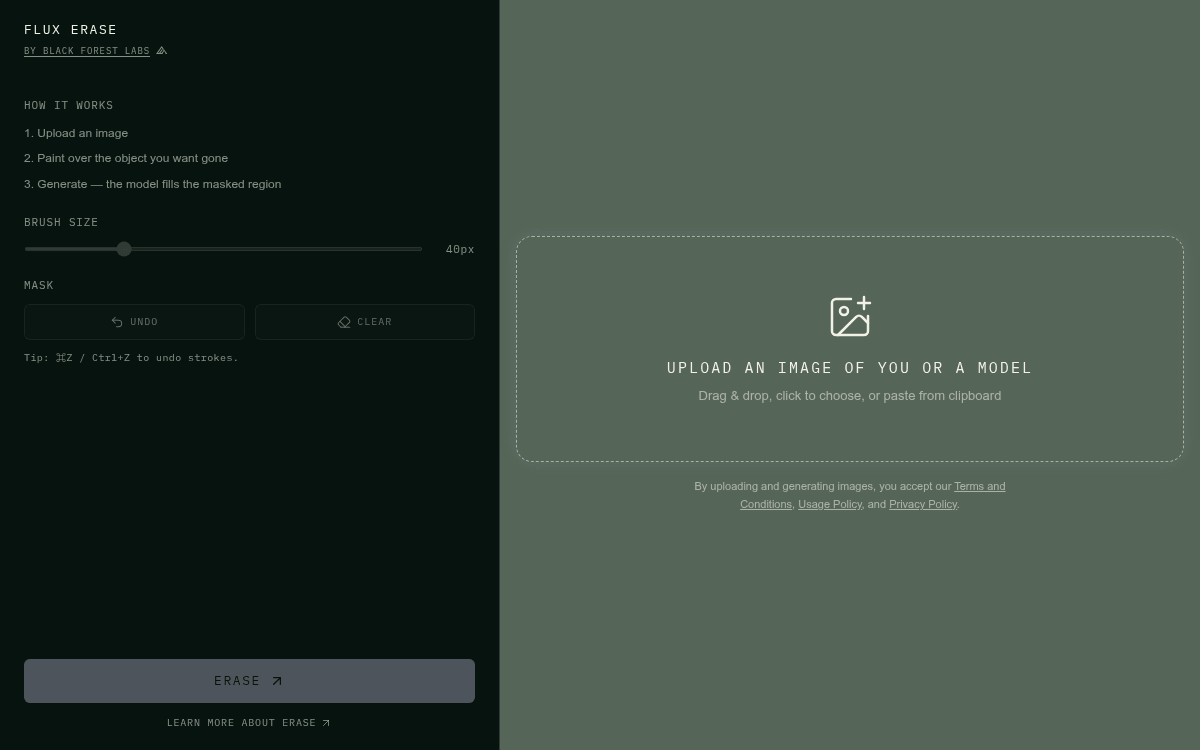
Object removal in images has always been a two-step frustration: mask the thing you want gone, then patch the hole with something that never quite matches the lighting or texture around it. Black Forest Labs just shipped FLUX Erase, and their approach is different enough to be worth paying attention to.
The problem with how removal tools usually work
Most inpainting tools treat erasure and reconstruction as separate concerns. You mark a region, the model fills it in, and you end up with halos, smearing, or a background that looks like it was generated by a different model -- because it essentially was. The fill has no real understanding of the scene it's supposed to blend into.
BFL's blog post lists the core failure modes of existing approaches:
- Visible artifacts: halos, smearing, and inconsistent texture at the edges of the removed area
- Incomplete reconstruction: background fill generated without understanding the full scene context
- Limited scope: tools trained narrowly on object removal that struggle with text, people, watermarks, or compositionally complex scenes
FLUX Erase removes whatever you mask -- including its traces like shadows and subtle parts missed by the mask -- and reconstructs the scene behind it coherently. That last part matters: if you erase a person standing in sunlight, the shadow they cast goes with them.
One model, one task, trained end-to-end
FLUX Erase removes the masked object and reconstructs the scene behind it with contextually coherent content in a single call, powered by FLUX.2 Klein 9B. The key design decision here is that erasure and reconstruction are trained as a single unified task rather than bolted together post-hoc.
FLUX.2 Klein 9B is a 9 billion parameter rectified flow transformer -- a generative architecture that learns to move from noise to image along smooth, straight paths rather than the zigzag trajectories of older diffusion models. It is built on a 9B flow model with an 8B Qwen3 text embedder, step-distilled to 4 inference steps. That distillation is what makes it fast enough to be practical in production pipelines.


Don't miss what's next in AI
Join 300,000+ engineers and researchers who get the signal, not the noise.
- Full access to in-depth AI research breakdowns
- Be the first to know what's trending before it hits mainstream
- Daily curated papers, repos, and industry moves