



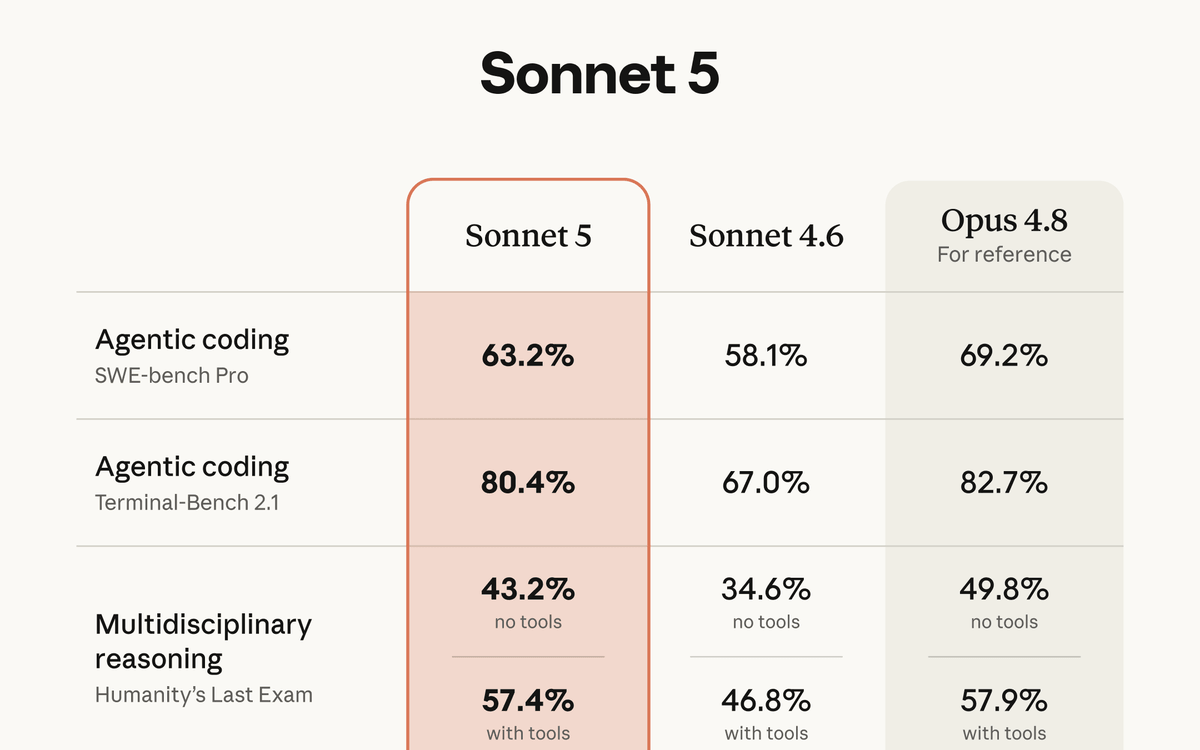
Anthropic just shipped Claude Sonnet 5, and the headline is hard to ignore: a mid-tier model that now performs close to Opus 4.8 across reasoning, coding, and agentic tasks, while keeping the same $3/$15 per million token pricing as its predecessor. It is live today across all Claude apps and the API, and it is the new default for Free and Pro users.
The model is positioned squarely as an agentic workhorse. Anthropic describes it as their "most agentic Sonnet yet" , one that makes plans, uses tools like browsers and terminals, and runs autonomously at a level that, just a few months ago, required reaching for a larger and more expensive Opus-class model.
The Agentic Leap That Actually Matters
The core story here is not just benchmark numbers. It is a qualitative shift in how the model behaves during long-running tasks. Early access partners reported that Sonnet 5 finishes complex tasks where previous Sonnets stopped short, and crucially, it checks its own output without being asked. That kind of unprompted self-correction is the difference between a model that assists and one that actually gets work done.
The agentic improvements show up in three concrete ways:
- Execution feedback loops: Sonnet 5 uses a built-in terminal environment to run the code it writes, identify errors, and self-correct before presenting a solution.
- Multi-file contextual awareness: The model maps out the entire dependency tree of a repository to ensure that a change in one file does not break a module three layers deep.


Don't miss what's next in AI
Join 300,000+ engineers and researchers who get the signal, not the noise.
- Full access to in-depth AI research breakdowns
- Be the first to know what's trending before it hits mainstream
- Daily curated papers, repos, and industry moves