

Anthropic's Claude Fable 5 Hits 88% on Math's Hardest AI Benchmark
Claude Fable 5 hits 88% on FrontierMath's hardest tier, up from under 10% just months ago — on a freshly error-corrected benchmark
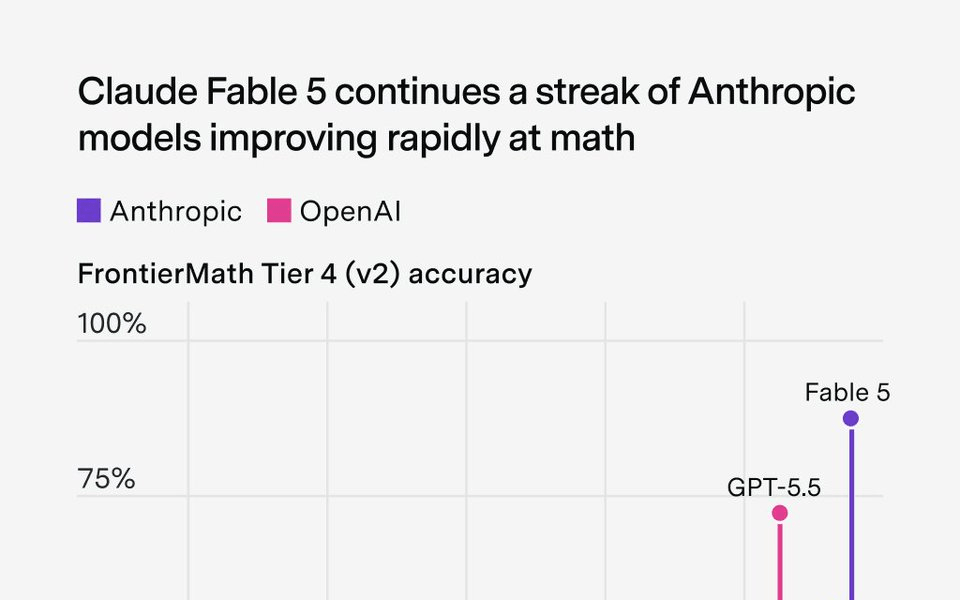
- Top score: Claude Fable 5 hits 87% on FrontierMath Tiers 1–3 and 88% on the hardest Tier 4, the highest scores Epoch AI has recorded.
- Massive leap: Predecessor Opus 4.5 scored below 10% on Tier 4 earlier in 2026 — Fable 5 represents a near-complete capability reversal in under a year.
- GPT-5.5 gap: OpenAI's GPT-5.5 reaches ~75% on Tier 4, putting Fable 5 roughly 13 points ahead on the benchmark's hardest tier.
- Benchmark overhaul: FrontierMath v2 launched simultaneously after an AI-assisted audit corrected errors in 42% of original problems; rankings held but scores rose across the board.
- Broader dominance: Fable 5 also leads SWE-Bench Pro at 80.3% and posts the lowest hallucination rate among frontier models at 36.18% on independent testing.
- Pricing and access: Available now at $10/$50 per million input/output tokens via the Claude API, Amazon Bedrock, Vertex AI, and Microsoft Foundry.
When FrontierMath launched in late 2024, every AI model tested solved fewer than 2% of its problems. That number just became a historical footnote. Claude Fable 5, Anthropic's newest and most capable model, now holds the top spot on the leaderboard, reaching 87% on Tiers 1–3 and 88% on Tier 4 , a streak of rapid improvement in Anthropic models' math capabilities. The results were published by Epoch AI, the independent research organization that runs the benchmark.
The benchmark that was built to break AI
FrontierMath is not a typical math test. The questions cover most major branches of modern mathematics , from computationally intensive problems in number theory and real analysis to abstract questions in algebraic geometry and category theory. Solving a typical problem requires multiple hours of effort from a researcher in the relevant branch of mathematics, and for the upper end questions, multiple days.
It was built with more than 60 mathematicians, including contributors holding 14 International Mathematical Olympiad gold medals and a Fields Medalist among the advisors. The benchmark is also deliberately "guessproof" , a term the team uses to mean that problems have large numerical answers or complex mathematical objects as solutions, with less than a 1% chance of guessing correctly without the mathematical work.
The four tiers escalate sharply in difficulty:
- Tiers 1–3: 350 original mathematics problems spanning from challenging university-level questions to problems that may take expert mathematicians days to solve.
- Tier 4: 50 extremely difficult problems developed as short-term research projects by mathematics professors and postdoctoral researchers , solving these tasks would provide evidence that AI can perform the complex reasoning needed for scientific breakthroughs in technical domains.
For each FrontierMath question, the model needs to submit a Python function answer() that returns the answer , often an integer or a SymPy object. This means models can use Python as a computational tool, but the reasoning still has to be genuinely mathematical.
A benchmark update that changes everything , and nothing
There is an important asterisk on these numbers. Epoch AI launched Version 2 of FrontierMath on the same day as the Fable 5 results, following an audit that addressed small but critical errors in 42% of problems in the original benchmark , though model rankings on v2 are similar, and scores are higher across the board.
The update corrected 123 problems in Tiers 1–3 and 12 problems in Tier 4, and also removed 5 problems from Tiers 1–3 and 7 from Tier 4. How did errors accumulate at that scale? Verifying expert mathematics at scale is genuinely hard, and it was AI itself that made the deeper audit possible , early human quality reviews had flagged something closer to 1 in 20 problems needing corrections, but a later AI-assisted audit surfaced the much higher rate.
The practical upshot: every "state of the art" claim made on the prior version was scored against a test that was wrong about two in five of its own questions. Rankings held, but the absolute numbers shifted, so pre-v2 and post-v2 scores are not directly comparable.
The numbers that matter
As recently as early 2026, predecessor model Opus 4.5 scored below 10% on Tier 4. OpenAI's GPT-5.5 reaches about 75% on the same tier, well behind Fable 5. A 13-point lead on FrontierMath Tier 4 matters because this benchmark is designed to be saturation-resistant, so large gaps between frontier models signal genuine capability differences rather than evaluation overfitting.
On Tiers 1–3, the picture is slightly more nuanced. A secondary leaderboard shows GPT-5.5 Pro at 87.7% ±1.9 and Claude Fable 5 at 87.0% ±2.0 , a 0.7-point gap inside overlapping error margins. The honest read: the two are effectively tied at the top of Tiers 1–3, and Fable 5 leads Tier 4 by roughly ten points.
The trajectory is what makes this remarkable:
- At FrontierMath's launch in November 2024, all six models evaluated solved fewer than 2% of problems.
- As recently as early 2026, Claude Opus 4.5 scored below 10% on Tier 4.
- Claude Fable 5 now scores 88% on that same tier.
- That is more than a fortyfold improvement in well under two years.
What Fable 5 actually is
Fable 5 is the first model from Anthropic's "Mythos-class" tier , the level that now sits above the Opus class , that it has cleared for general use. Alongside it came Claude Mythos 5, the same underlying model with some of its safeguards lifted, available only to a small group of cyber defenders and infrastructure providers.
The two products use the same underlying model, but Fable 5 includes safety fallbacks that send some sensitive requests to Claude Opus 4.8, while Mythos 5 exposes more of the full model for approved cybersecurity and life sciences users. Anthropic's early data shows that more than 95% of Fable sessions never trigger a fallback, so most users will never notice the distinction.
The underlying model was trained on a proprietary mix of publicly available internet data, public and private datasets, and synthetic data generated by other models. It underwent substantial post-training and fine-tuning with the same pretrained parameters and constitutional alignment data. The extended thinking capability Anthropic introduced with Claude 3.7 carries forward and is further developed in Fable 5 , the model can allocate more deliberate internal processing to problems that require it, rather than relying entirely on pattern-matching from training.
All models were tested on Epoch AI's standard scaffold with maximum reasoning effort.
Beyond math: what else Fable 5 does well
The math gains are the headline, but they are part of a broader capability jump. On SWE-Bench Pro, Fable 5 scored 80.3%, ahead of Opus 4.8's 69.2%, GPT-5.5's 58.6%, and Gemini 3.1 Pro's 54.2%. On Humanity's Last Exam, the model scored 59.0% without tools and 64.5% with tools.
It also posts by far the lowest hallucination rate of the three major frontier models on an independent benchmark , 36.18% versus Gemini's 49.87% and GPT-5.5's 85.53%. For teams where wrong answers carry real costs, that gap matters more than any single benchmark score.
Practical use cases where Fable 5 pulls ahead of alternatives:
- Complex code generation , writing or debugging code across a large codebase, especially when the model needs to understand dependencies and architecture before making changes.
- Long-horizon reasoning , strategic analysis, research synthesis, and product planning where the model needs to hold many variables in mind and reason through them carefully.
- Multi-agent orchestration , Fable 5 works well as the "brain" in a multi-agent system, deciding what sub-agents to call and how to integrate their outputs.
- Document-heavy work , it understands diagrams, charts, and tables nested in files and PDFs, improving work across finance, legal, analytics, and architecture.
Pricing and access
Claude Fable 5 is priced at $10 per million input tokens and $50 per million output tokens, with the existing 90% input token discount for prompt caching. It is generally available on the Claude API, Claude Platform on AWS, Amazon Bedrock, Vertex AI, and Microsoft Foundry. You can call it with claude-fable-5 via the Claude API.
What the field needs to update
The FrontierMath trajectory forces a recalibration of what "research-level math" means as an AI capability threshold. Solving these tasks was supposed to provide evidence that AI can perform the complex reasoning needed for scientific breakthroughs in technical domains , and that bar has now been cleared at 88% accuracy. These math gains are not just in benchmarks: real-world examples keep stacking up, including an OpenAI model solving a longstanding Erdős problem, and so did Claude Mythos.
The jump from Opus 4.5's sub-10% to Fable 5's 88% on the hardest tier within a single year compresses what historically required a generation of research progress. The more uncomfortable implication is that the benchmark community is now in a race to stay ahead of the models it is trying to evaluate. Epoch AI acknowledges it cannot be sure all errors have been caught, and plans to conduct additional AI-assisted reviews periodically using new frontier models. In other words, the best tool for auditing a math benchmark is now the same class of model the benchmark is trying to measure.
Comments
