



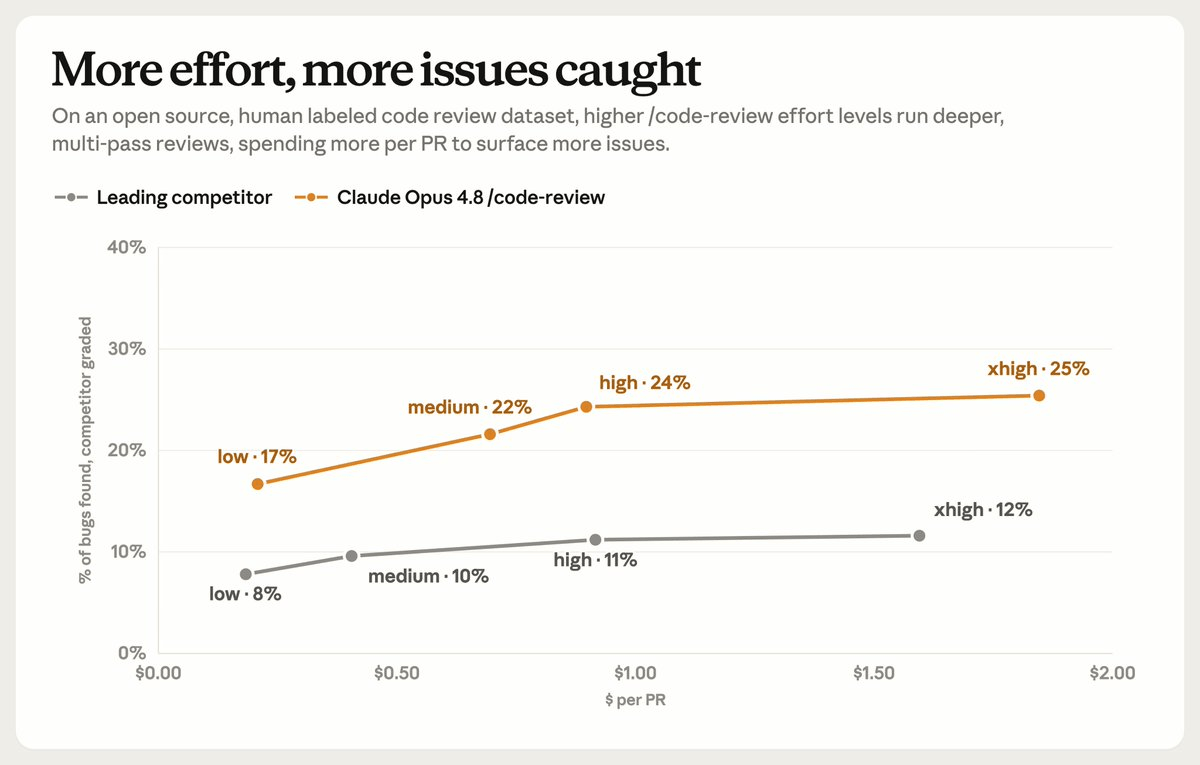
Claude Code's /code-review command just got a major overhaul. What was previously a single fixed prompt now spans five distinct effort levels, each running a completely different review strategy. And at the top sits /code-review ultra , a cloud-hosted fleet of reviewer agents that independently verifies every finding before surfacing it. When you run /code-review ultra, Claude Code launches a fleet of reviewer agents in a remote sandbox to find bugs in your branch or pull request.
The five-tier ladder
The key insight here is that each level is not just "more compute" , it's a fundamentally different review architecture. Here's how the tiers break down:
- Low: A single fast pass over the diff. Low and medium return fewer, higher-confidence findings. These levels work well for small patches, config changes, or situations where you want a fast sanity check before pushing. They complete in seconds and focus on clear-cut correctness bugs.
- Medium: Reads the changed code in context, runs multiple finder passes from different angles, then verifies every finding before surfacing it.
- High: Runs finders and verifiers as subagents with fresh context windows, so they aren't anchored on the reasoning of the agent that just wrote the code.
- Max (x-high): Goes even further, sweeping for impacts to code outside of the change itself , catching regressions in callers and dependents.
- Ultra: Ultrareview offers higher signal (every reported finding is independently reproduced and verified, so the results focus on real bugs rather than style suggestions) and broader coverage (a larger fleet of reviewer agents explores the change in parallel, which surfaces issues that a local review can miss).
Lower effort levels return fewer, higher-confidence findings, while high through max give broader coverage and may include uncertain findings. Without an effort argument, the review uses the session's current effort. You can also pass a level explicitly , e.g. /code-review high , to override the session default.
What makes Ultra different
The architectural leap at the ultra tier is not just parallelism , it's the verification step. Not because it found bugs , any decent linter finds bugs. Because it found bugs, then proved they were real before telling you about them. And that second part? That's the part nobody else is doing.


Don't miss what's next in AI
Join 300,000+ engineers and researchers who get the signal, not the noise.
- Full access to in-depth AI research breakdowns
- Be the first to know what's trending before it hits mainstream
- Daily curated papers, repos, and industry moves