

Anthropic Makes Claude Artifacts Multiplayer so Teams Can Build Together
Claude Artifacts now support real-time multiplayer editing, public sharing links, and Claude Tag can build internal tools directly from Slack threads
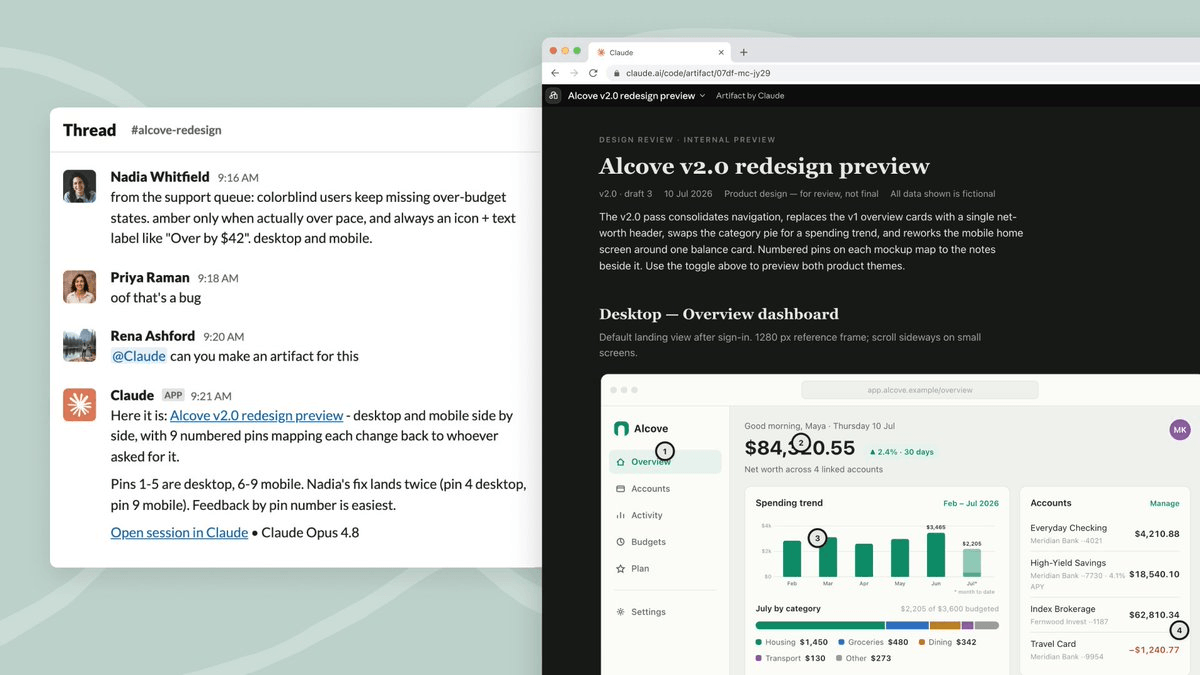
- Claude Artifacts now support real-time multiplayer editing on Team and Enterprise plans, ending the version-passing workflow.
- Public sharing is live on Free, Pro, and Max plans -- anyone with the link can view and interact, no Claude account required.
- Claude Tag can now build internal artifacts directly from a Slack thread, returning a working dashboard scoped to your org.
- Claude Code Artifacts are now available on Pro, Max, Team, and Enterprise -- expanded from the original Team/Enterprise-only beta.
- Artifacts are built from full session context (codebase, MCP connectors, conversation history) -- no extra infrastructure needed.
- Key limits: no custom domains, single-file output only, and Team/Enterprise artifacts cannot be published publicly.
Anthropic just shipped a meaningful upgrade to how teams work with Claude Artifacts. The headline: Artifacts are now multiplayer. Multiple people can edit the same artifact at the same time, public sharing via link is now live, and Claude Tag can generate internal artifacts directly from a Slack thread. Together, these changes push Artifacts from a personal prototyping tool into something that looks a lot more like a shared product surface.
What just changed
Three things landed in this update:
- Multiplayer editing -- by default, artifacts in Claude Code are only visible to the individual who created them, but they can now choose to share artifacts with the rest of their organization. The new multiplayer mode lets multiple teammates edit the same artifact simultaneously, without passing file versions around.
- Public sharing -- publishing makes an artifact publicly available, and anyone with the link can view and interact with it. Recipients do not need a Claude account to view published artifacts, and users with an account can remix them -- creating their own editable copy.
- Claude Tag can now build internal artifacts -- ask for a dashboard in a Slack thread and Claude Tag returns a working, shareable page scoped to your organization.
The plan split you need to know
Not everything is available everywhere. The access model is a bit layered:
- Multiplayer editing: Team and Enterprise plans only.
- Public sharing (Publish): available on Free, Pro, and Max plans -- makes an artifact publicly available and anyone with the link can view and interact with it.
- Org-scoped sharing (Share): Team and Enterprise only -- makes the artifact available within your organization, with viewers required to be logged into your Team or Enterprise account.
- Claude Code Artifacts: as of July 2026, available on Pro, Max, Team, and Enterprise -- though on Pro and Max the artifact stays private to you, with no sharing at all.
One important caveat: artifacts created on Team or Enterprise accounts can only be shared within your organization -- they cannot be published publicly. The public sharing feature is for personal plans.
What Claude Code Artifacts actually are
A Claude Code session can range from investigating an incident to refactoring a service to analyzing months of data. Artifacts translate the work into a web page anyone can open and explore -- like a pull request walkthrough, a dashboard you can filter and sort, or even a release checklist that fills itself out as work gets done.
What makes these different from the chat Artifacts that launched back in 2024 is grounding. An artifact is built from three session sources: the local repository codebase, connected tools or plugins via MCP, and the conversation history that produced the work. Engineers do not need to wire up external data sources or stand up infrastructure -- the material already exists inside the session.
The output is a self-contained HTML page hosted at a claude.ai URL. Every publish creates a new version at the same URL, and users can restore any prior version from the Share control -- so a teammate watching the link sees the work evolve without you re-sending anything.
Claude Tag's new artifact power
Claude Tag -- Anthropic's Slack-native AI agent that you summon with @Claude -- can now build internal artifacts directly from a thread. The workflow: ask for a dashboard in a Slack channel, and Claude Tag returns a working page scoped to your organization, no context-switching required.
Tagging Claude comes with a multiplayer advantage: within a given Slack channel, there's one Claude that interacts with everyone. This means that anyone can see what it's working on, and can pick up the conversation from where the last person left off. This makes tagging Claude very different from working within a single chat -- it's much more like interacting collaboratively with a teammate.
Anthropic reports that 65% of their product team's code is now created by their internal version of Claude Tag -- a striking signal of how far they've taken this internally before shipping it broadly.
Practical use cases
The clearest wins are in developer and team workflows where the output of an AI session needs to be handed off to someone who wasn't in the session:
- PR walkthroughs: a developer can generate a visual, interactive walkthrough of code changes rather than leaving reviewers to parse raw diffs.
- Incident dashboards: a single incident page can bring together the failing test and the function behind it from your code, the error spike from a connected monitoring tool, and the root-cause reasoning from the session you just ran.
- Internal tools from Slack: ask for a metrics dashboard in a channel thread, get a working page back, shareable within the org.
- Public prototypes: build a tool in Claude, publish it with one click, and share it with anyone -- no deployment infrastructure needed.
What's still missing
The feature is genuinely useful but has real edges. Custom domains are not mentioned -- artifacts are hosted by Anthropic and viewed at their URL. A standard artifact is a single file, and multi-file projects cannot be split across files inside the same artifact -- the workaround is to inline everything. And AI-powered artifacts that make API calls back to Claude at runtime still require authentication, and published artifacts may be indexed by search engines -- so be careful about what you make public.
The bigger picture
This update is part of a broader pattern Anthropic has been building toward. The combination of live rendering, iterative conversation-based development, public sharing, remixing, and a sandboxed runtime that can call Claude itself has established Artifacts as a new paradigm for human-AI creative collaboration.
Gemini Canvas added live HTML and React preview in 2025, which closes some of the gap with Artifacts, but it lacks public URL sharing and an in-artifact AI runtime. The multiplayer editing and Claude Tag integration are the moves that push Claude's Artifacts further ahead of what competitors have shipped so far.
The trajectory is clear: Anthropic continues to expand the supported libraries, improve rendering performance, and ship new capabilities, with the trajectory clearly pointing at a microapp platform rather than a chat output panel. Multiplayer editing and public sharing are the next logical step on that path -- turning Artifacts from a personal scratchpad into a lightweight app-shipping surface for teams.
Comments
