



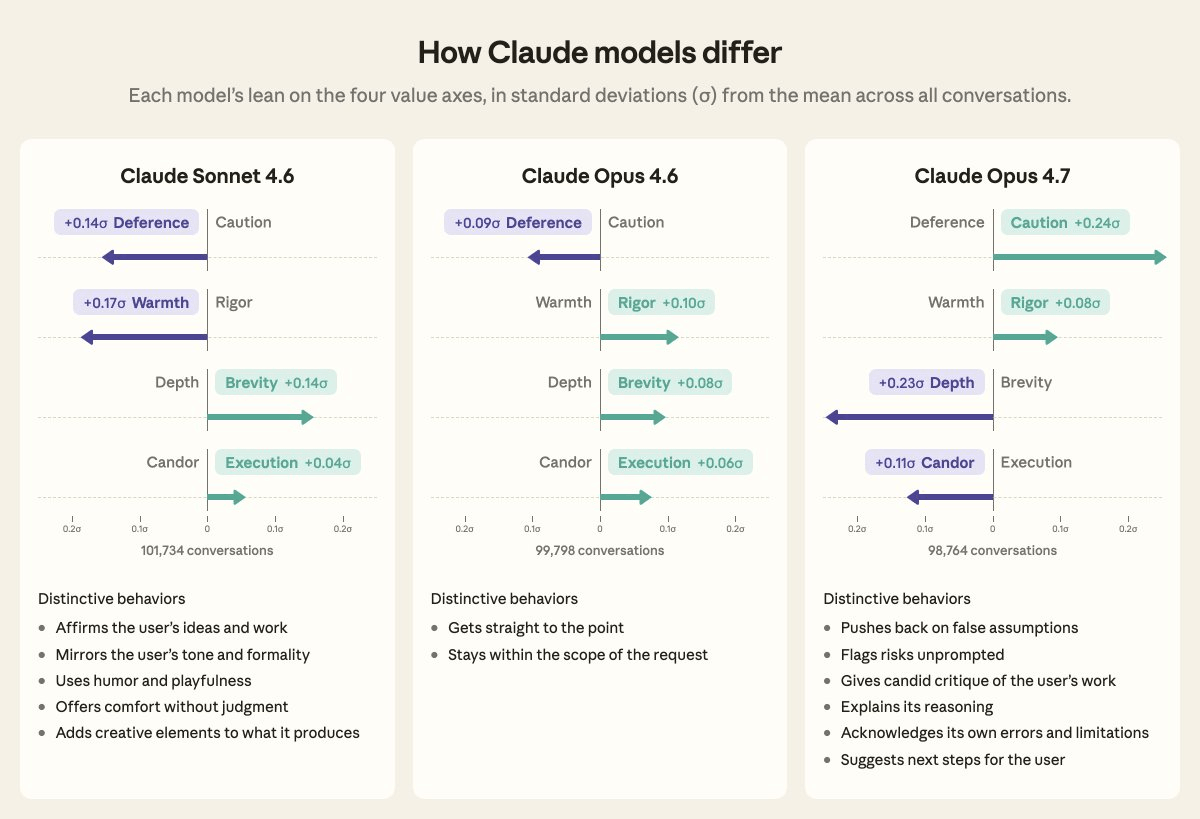
When you ask Claude whether to quit your job or how to handle a difficult relationship, there is no objectively correct answer. Claude has to exercise judgment, and that judgment reflects values. But which values? And does Claude express the same values in English as it does in Arabic? Does Opus behave differently from Sonnet at a character level, not just a capability level? Anthropic's Societal Impacts team set out to answer exactly these questions, and the results are more structured than you might expect.
The new research builds directly on Anthropic's earlier Values in the Wild study, which analyzed a sample of 700,000 anonymized conversations and revealed how Claude expresses 3,307 unique values in real-world interactions. The problem with 3,307 values is that it is nearly impossible to reason about them or track how they shift. The new work solves that by compressing the entire space into four interpretable axes.
The measurement problem
AI alignment research has long struggled with a gap: you can write a constitution describing what values a model should have, but you cannot easily verify whether those values actually show up in deployment. As with any aspect of AI training, you cannot be certain the model will stick to preferred values. AIs are not rigidly-programmed pieces of software, and it is often unclear exactly why they produce any given answer. What is needed is a way of rigorously observing the values of an AI model as it responds to users in the wild.
The new study addresses this directly. The researchers analyzed 300,000 real conversations to measure the values Claude expresses across models and languages, compressed into four interpretable axes. Each axis is a number line between two groups of values, and where Claude falls on that line tells us which values it leans toward.
Building the four axes
The methodology is worth understanding in detail because it is the real contribution here. The team started with the 3,307 values from the prior study, manually clustered them into 339 high-level values, then sampled 309,815 Claude.ai conversations in which the user gave Claude a subjective task. The sample drew equally from three models (Sonnet 4.6, Opus 4.6, Opus 4.7) and the 20 most common languages used on Claude.ai, giving roughly 5,000 conversations per model-language pair.


Don't miss what's next in AI
Join 300,000+ engineers and researchers who get the signal, not the noise.
- Full access to in-depth AI research breakdowns
- Be the first to know what's trending before it hits mainstream
- Daily curated papers, repos, and industry moves