

Alibaba's Qwen3.8-Max Breaks Open Its Most Powerful Model Ever
Alibaba's 2.4T MoE flagship matches Claude Fable 5 on agentic evals and is about to become the largest open-weight model ever released

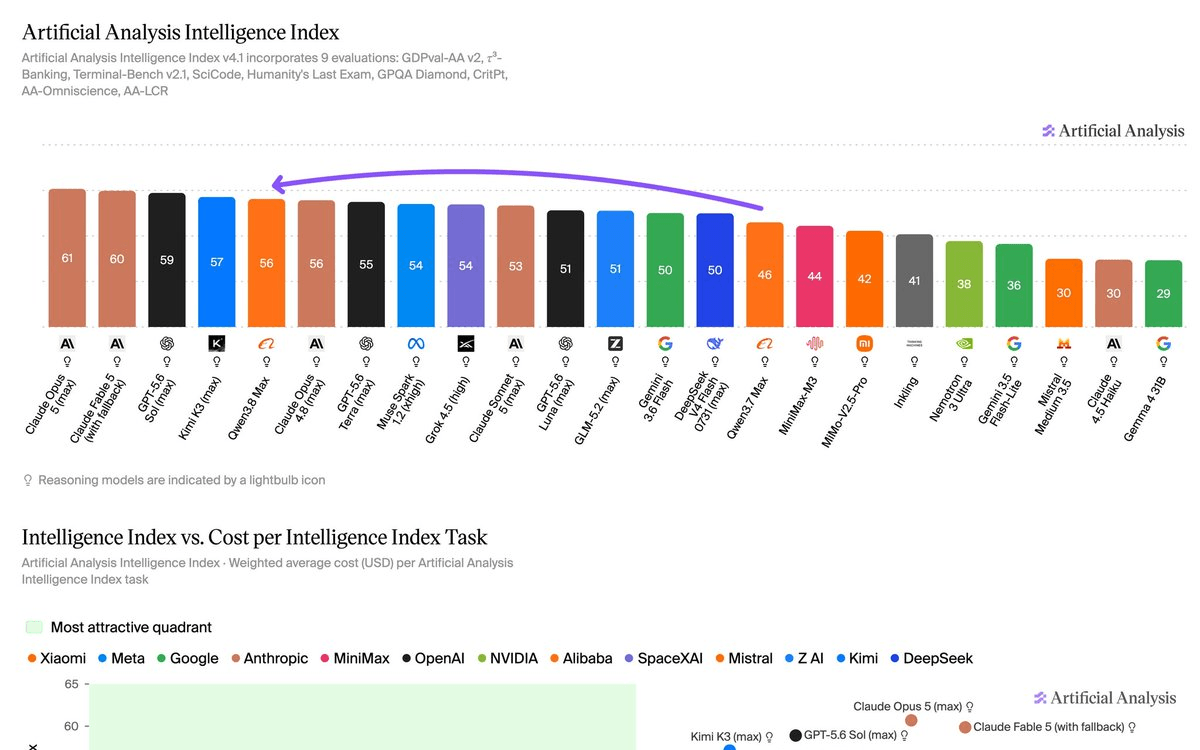
- Qwen3.8-Max released: Alibaba's 2.4T-parameter MoE flagship is live on the API, with open weights dropping next week — a first for any Max-class Qwen model.
- Agentic performance: Scores 1739 Elo on GDPval-AA, effectively tied with Claude Fable 5 (1743) and GPT-5.6 Sol (1730), driven by 64 turns per task vs. 14 for its predecessor.
- Pricing: $2/$6 per million input/output tokens with $0.25 cache hits; OpenAI and Anthropic API compatible via base-URL swap.
- Key regression: Hallucination rate rose from 23% to 40% on knowledge tasks; SWE-bench Pro (67.7) still trails Claude Fable 5 (80.0).
- Open-weight strategy shift: Once released, it will be the second-largest open-weight model ever (2.4T), behind Kimi K3 (2.8T); a smaller Qwen3.8-27B is also going open for on-premise use.
- Industry context: Alibaba matches GPT-5.6 pricing head-on as Chinese labs race to combine frontier capability with open-weight accessibility against Western closed models.
Alibaba just released Qwen3.8-Max, its most capable model to date and, crucially, the first Max-class Qwen model that will ever ship as open weights. Every previous Max-tier model stayed locked behind the API. This one won't. The weights are promised for next week on Hugging Face and ModelScope, alongside a smaller Qwen3.8-27B checkpoint that will actually fit on-premise hardware.
A model built for agents, not just chat
The headline numbers: 2.4 trillion total parameters, 95 billion active per token, a 1M-token context window, and native text plus vision input. The MoE design (Mixture-of-Experts) means only a fraction of the network fires on any given token, keeping inference cost far lower than the raw parameter count implies. To keep operational costs and response latency manageable, the model routes tasks through specialized subsystems, activating only 95 billion parameters at any given time.
Built on the Qwen 3.5 architecture, Qwen3.8-Max combines a Sparse Mixture-of-Experts design with a hybrid attention mechanism. Alibaba says this architecture enables large-scale models to generate inference results efficiently. Reinforcement learning was scaled across million-agent environments with progressively complex task distributions for robust real-world adaptability. Alibaba's own RL scaling curve does show diminishing returns past ~4,000 training environments, so the gains are real but not unlimited.
What the benchmarks actually say
Independent evaluation from Artificial Analysis puts Qwen3.8-Max at 56 on the Artificial Analysis Intelligence Index, up 10 points from Qwen3.7-Max (46). On GDPval-AA, the agentic benchmark that simulates multi-step real-world tasks, it scores 1739 Elo , a 468-point jump over its predecessor. That places it:
- Ahead of Kimi K3 (1685 Elo)
- Effectively tied with Claude Fable 5 (1743) and GPT-5.6 Sol (1730)