

Alibaba's Qwen Robot Suite Beats π0.5 by 3x on Cross-Embodiment Tasks
Alibaba's Qwen team releases three foundation models for navigation, manipulation, and world simulation — a full-stack toolkit for robots that act in the physical world

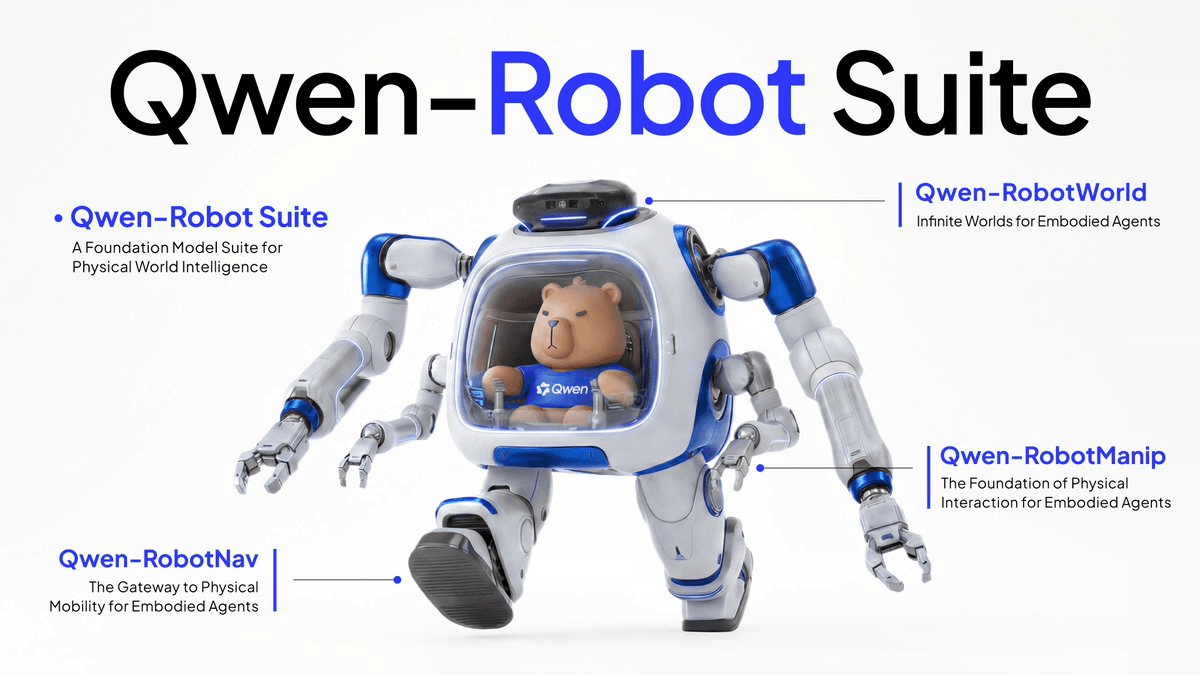
- Alibaba launches Qwen-Robot Suite: three foundation models (Nav, Manip, World) forming a full stack for embodied AI.
- Qwen-RobotManip tops RoboChallenge generalist track with 45% task success and 59.83 process score, beating π0.5 across all OOD benchmarks.
- The 38,100-hour training corpus was built entirely from open-source data and egocentric human videos — no proprietary robot data collection.
- Camera-frame delta pose representation enables 3.2x better zero-shot cross-embodiment transfer vs. π0.5 on unseen robot morphologies.
- Qwen-RobotWorld ranks 1st on EWMBench and DreamGen Bench, using natural language as a universal action interface across manipulation, driving, and navigation.
- Models are in pilot testing with Alibaba Cloud enterprise customers; code available on GitHub.
The gap between AI that understands the world and AI that can act in it has been the defining bottleneck for embodied intelligence. The Qwen family of foundation models already gives strong perception and reasoning about the physical world , but seeing is not acting: the gap between vision-language understanding and physical control remains the central bottleneck. Alibaba's Qwen team just took a serious swing at closing it.
Alibaba has launched the Qwen Robot Suite, a set of three foundation models for robotics developed by its Tongyi Lab: Qwen-RobotNav for vision-language navigation, Qwen-RobotWorld as a video-based world model for prediction and simulation, and Qwen-RobotManip as a generalist vision-language-action (VLA) model. The suite has already entered pilot testing with selected Alibaba Cloud enterprise clients.
Three models, one stack
The suite splits robot intelligence into three interconnected layers. Qwen-RobotNav, a vision-language navigation model, is designed to help machines understand and move through physical spaces. It works in tandem with Qwen-RobotWorld, a video world model that lets robots predict and simulate how physical scenes will evolve before they take action. Then the physical execution is handled by Qwen-RobotManip, a generalist vision-language-action model built on the Qwen3.5-4B architecture.
Each model is independently deployable, but the real value is in the stack. Think of it as perception (Nav), imagination (World), and action (Manip) , three modules that together give a robot the ability to navigate a space, mentally simulate what will happen next, and then physically execute a task.
Qwen-RobotManip: alignment before scale
Qwen-RobotManip is a generalizable Vision-Language-Action (VLA) foundation model built upon Qwen-VL. It introduces a unified alignment framework across the representation, motion, and behavioral dimensions of manipulation, making large-scale multi-source training coherent rather than conflicting.
The core insight is that alignment is a prerequisite for data scaling , not an independent engineering choice. When demonstrations from different robots arrive with incompatible action representations, adding more data produces interference rather than synergy. The team's solution has three parts:
- Canonical state-action representation: An 80-dimensional vector that accommodates joint positions, end-effector poses, gripper state, and dexterous hand joints across any robot morphology, with zero-padded dimensions masked out of the training loss.
- Camera-frame delta pose: End-effector actions are expressed as pose deltas in the camera's coordinate frame rather than the robot's base frame. This means physically similar motions look numerically similar regardless of which robot is doing them , a key enabler for cross-embodiment transfer.
- In-context policy adaptation: The model reads a window of recent observation-action history during an episode, letting it adapt its behavior at deployment time without any parameter updates , analogous to in-context learning in LLMs.
A human-to-robot synthesis pipeline converts egocentric hand demonstrations into robot trajectories across 15 platforms, and a rigorous curation pipeline harmonizes heterogeneous real-robot and synthetic datasets, together accumulating approximately 38,100 hours of manipulation data. Notably, this entire corpus is constructed from only open-source robotic manipulation datasets and egocentric human videos without any proprietary data collection.
The training corpus breakdown is instructive:
- 3,808 hours of single-arm robot data from OXE, RoboMIND, DROID, RH20T, and others
- 6,744 hours of dual-arm tabletop data
- 1,933 hours of egocentric human hand videos (EgoDex, VITRA, EgoVerse)
- 24,808 hours of synthesized human-to-robot demonstrations across 15 robot morphologies
The synthesis pipeline is clever: given a first-person human video, it segments the hands out using SAM3, inpaints the background with ProPainter, retargets the hand trajectories to robot end-effectors, and renders 15 different robot arm configurations into the scene using MuJoCo inverse kinematics. One human video becomes 15 robot training samples.
The benchmarks tell a story about evaluation, not just performance
Qwen-RobotManip achieves substantially better performance than prior state-of-the-art models, including π0.5, across all OOD settings, ranks 1st in RoboChallenge with a 20% relative improvement, and is validated on real-robot platforms including AgileX ALOHA, Franka, UR, and ARX.
But the paper makes a pointed argument about how the field measures progress. Standard in-domain benchmarks, where models without large-scale robot pretraining match or exceed pretrained ones, systematically fail to distinguish genuine generalization from in-distribution pattern matching. OOD evaluation is the correct north star for measuring foundation model quality. The team introduces two new benchmarks to make this concrete:
- RoboTwin-IF (Instruction Following): tests whether a policy actually uses language as a control signal, or just matches visual patterns. Qwen-RobotManip scores 72.2% vs. π0.5's 49.6%.
- RoboTwin-XE (Cross-Embodiment): zero-shot transfer to unseen robot morphologies. Qwen-RobotManip achieves 23.9% average success using camera-frame EEF actions , 3.2x the 7.5% achieved by π0.5.
On real hardware, the numbers are striking. On the CobotMagic ALOHA platform, Qwen-RobotManip achieves an average success rate of 88.6%, significantly outperforming π0.5 (42.9%) and StarVLA (20.0%). In the out-of-domain setting, Qwen-RobotManip achieves an average success rate of 87.5%, compared with 37.5% for π0.5 and 0.0% for StarVLA.
Qwen-RobotWorld: language as a universal action interface
Qwen-RobotWorld is a language-conditioned video world model for embodied intelligence. With natural language as a unified action interface, it predicts physically grounded future visual trajectories from current observations across robotic manipulation, autonomous driving, indoor navigation, and human-to-robot transfer.
The key architectural decision is using a frozen Qwen2.5-VL as the action encoder inside a 60-layer double-stream Multimodal Diffusion Transformer (MMDiT , a transformer that processes two streams of data, text and video, with joint attention between them at every layer). This gives the model deep language understanding for parsing complex instructions, plus internalized world knowledge about physics that constrains what it generates.
The Embodied World Knowledge (EWK) dataset spans approximately 8.6M video-text pairs comprising over 200M observation frames, covering manipulation (20+ robot morphologies, 1300+ skills), autonomous driving, indoor navigation, and human-to-robot transfer data. The action-language mapping framework is the key data contribution: it converts joint angles, steering commands, and navigation waypoints from 500+ action categories into natural language, so a Franka gripper, an autonomous vehicle, and a humanoid all train under the same interface.
Qwen-RobotWorld ranks 1st overall on EWMBench and DreamGen Bench, outperforms all open-source models on WorldModelBench and PBench. Beyond benchmarks, it enables three practical applications: generating synthetic training data for VLA policies, serving as a simulation environment for policy evaluation, and providing language-guided planning signals for robot control.
Qwen-RobotNav: navigation as a parametric interface
Qwen-RobotNav, built on Qwen3-VL, tackles the problem of robot navigation with a parametric interface that separates two concerns: what kind of navigation task to perform (instruction following, point-goal, object-goal, target tracking, or autonomous driving), and how to encode visual history (token budget, temporal decay, per-camera weights). This model unifies five major task groups including language instruction navigation, target search, and autonomous driving into a single framework. Traditional VLN models generally face the issue of rigid memory strategies , too little memory causes robots to get lost, too much leads to confusion. Qwen-RobotNav introduces a task-adaptive observation mechanism to flexibly adjust memory strategies based on task type.
Trained on 15.6 million samples with randomization over all parameters, the model generalizes to any inference-time configuration without architectural changes. The model features a universal interface design that can be called directly by upper-layer models, making it one of the few VLN models in the industry natively supporting multiple agent frameworks.
What this means for the field
The Qwen-Robot Suite is significant for a few reasons that go beyond benchmark numbers. First, the entire 38,100-hour manipulation corpus was built without proprietary data collection , only open-source datasets and public egocentric videos. This suggests the data barrier for manipulation foundation models is lower than commonly assumed, if you have the right synthesis and curation infrastructure.
Second, the camera-frame delta pose representation is a genuine contribution to the cross-embodiment problem. By expressing actions in the visual coordinate frame, the same physical motion becomes numerically similar across morphologically different robots. The ablations show this isn't just a design choice , without it, data scaling produces erratic results rather than clean log-linear improvement curves.
Third, the suite challenges a widespread assumption in VLA evaluation: that standard in-distribution benchmarks measure what matters. Standard benchmarks consistently fail to distinguish models whose pretraining contributes genuine generalizable structure from those that succeed through in-distribution pattern matching. The new OOD benchmarks introduced here , RoboTwin-IF and RoboTwin-XE , are likely to become reference points for the field.
The models are currently in pilot with Alibaba Cloud enterprise customers. Technical reports for all three models are available: Qwen-RobotManip, Qwen-RobotWorld, and Qwen-RobotNav, with code for RobotManip on GitHub. The remaining gap is real-world breadth: the OOD evaluations, while substantially harder than standard benchmarks, are still predominantly simulation-based, and the fixed action chunk length limits applicability to tasks requiring sub-second reactive control.
Comments
