


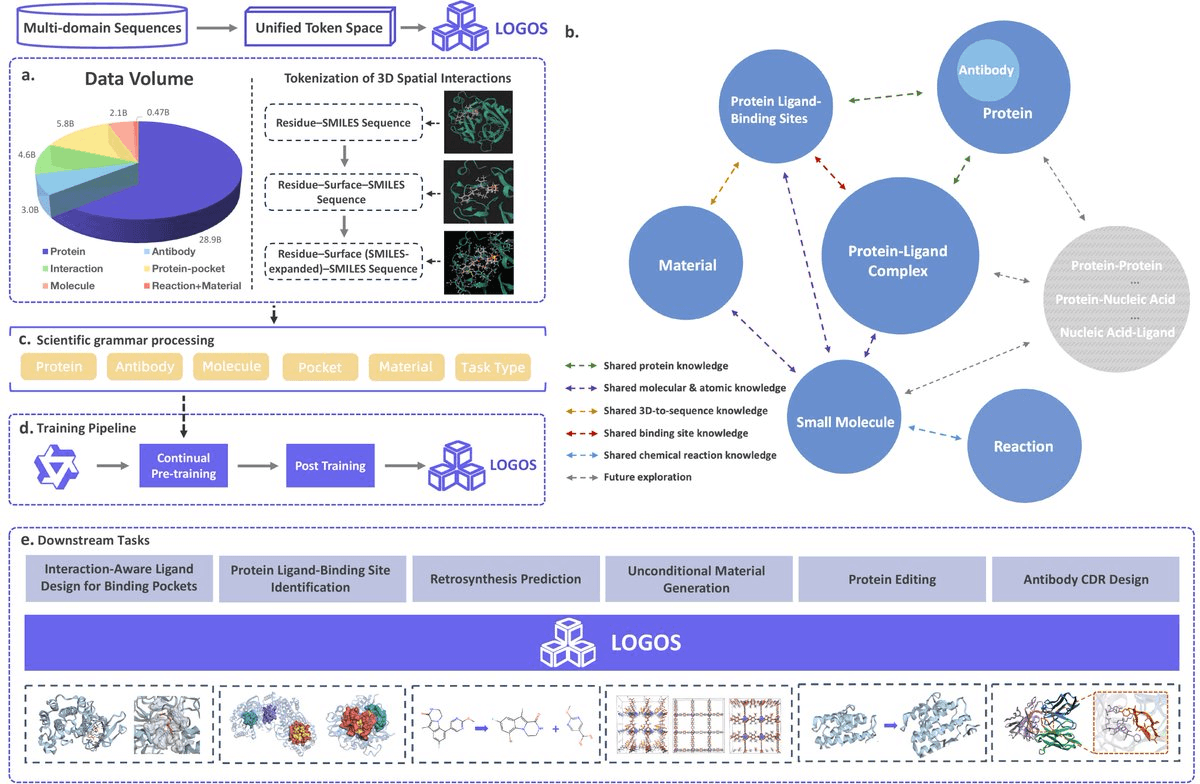
The dominant playbook for AI in science has always been specialization: one model for protein folding, another for drug design, a third for materials discovery. Every new task means a new architecture, a new training pipeline, and knowledge that never leaves its silo. LOGOS (Language Of Generative Objects in Science), a new open-source model from Alibaba's Tongyi Lab and Renmin University of China, is a direct challenge to that assumption.
LOGOS is a scientific generative language model that unifies heterogeneous tasks across the natural sciences within a single autoregressive framework based on a shared scientific grammar. In plain terms: instead of building separate specialist models, the team asked whether scientific data could be treated like language, and whether a single next-token prediction engine could handle all of it.
One grammar to rule them all
The core idea is a unified scientific grammar -- a shared vocabulary that encodes radically different scientific objects (proteins, small molecules, antibodies, chemical reactions, crystal materials) as token sequences. This is not a natural-language wrapper around existing tools. By representing spatial contact and constraint patterns as discrete tokens, the model captures complex structural interactions in a purely sequential manner, without relying on explicit coordinates or geometric neural networks.
That last point is significant. Most structure-aware models in biology and chemistry rely on 3D geometric deep learning -- specialized architectures that explicitly reason about atomic coordinates in space. LOGOS sidesteps this entirely, discretizing spatial relationships into tokens that the transformer can process like any other sequence.


Don't miss what's next in AI
Join 300,000+ engineers and researchers who get the signal, not the noise.
- Full access to in-depth AI research breakdowns
- Be the first to know what's trending before it hits mainstream
- Daily curated papers, repos, and industry moves